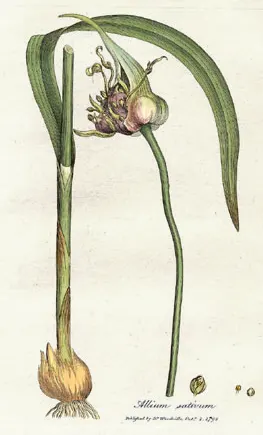
Photo: Public domain (via Wikimedia Commons)
Garlic
Allium sativum
Also known as Stinking Rose, Poor Man's Treacle, Rustic Treacle, Camphor of the Poor
Key benefits
✦Traditional uses
✦Garlic has followed humanity through nearly every kitchen and medicine chest on earth, from the laborers of ancient Egypt who were rationed bulbs to keep their strength up, to Greek and Roman soldiers who carried it into battle for courage and resilience. Long before germ theory existed, healers across Asia, the Mediterranean, and Europe reached for garlic to ward off infection, ease coughs, and settle a troubled stomach. During times of plague and war, when other medicines ran scarce, garlic earned its old nickname of the poor man's treacle, a humble but trusted cure-all. Its reputation as both food and medicine has never really faded, it simply moved from the herbalist's satchel to the everyday spice rack.
How to grow & use it
✦The full apothecary for Garlic
Traditional remedies and step-by-step preparations, a complete growing guide, and how to harvest, dry, and store it, all unlocked with HerbLens Unlimited.
- ✦Remedies & preparations
- ✦ Growing guide
- ✦Harvest & storage
From under $6 a month. Free plant identifications always included.
- ✦Ginger
- ✦Thyme
- ✦Honey
- ✦Onion
- ✦Shallot
“You want the old, dependable ally that has guarded thresholds, seasoned suppers, and steadied hearts for thousands of years.”
Garlic bulbs were found in the tomb of Tutankhamun, and ancient Egyptian records show laborers building the pyramids were given a daily garlic ration, believed to keep them strong enough for the grueling work.
Garlic is safe in normal cooking amounts, but medicinal or concentrated doses can thin the blood, so use caution with blood-thinning medication or before surgery. Raw garlic applied to skin can cause burns or irritation.