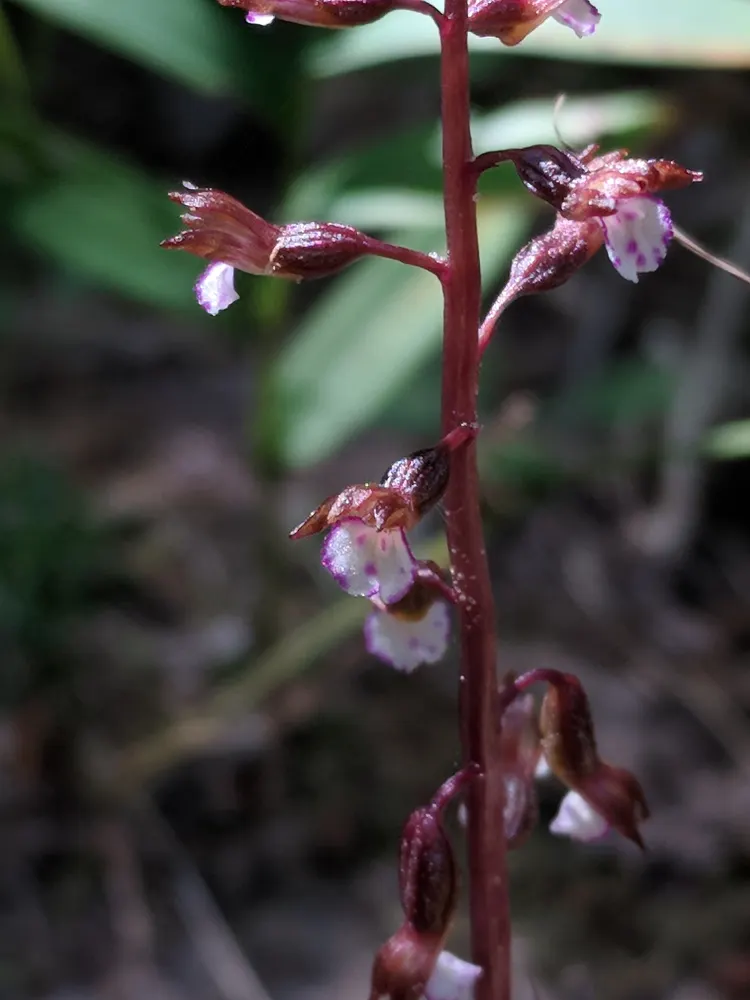
Photo: Nate Martineau, CC BY 4.0 (via Wikimedia Commons)
Autumn Coralroot
Corallorhiza odontorhiza
Also known as Fall Coralroot, Late Coralroot, Small-flowered Coralroot, Dragon's Claw
Key benefits
✦Traditional uses
✦Autumn coralroot is one of the quiet oddities of the American woodland, a plant with no green leaves at all, living instead off a partnership with underground fungi. Nineteenth century Eclectic physicians and earlier folk practitioners dug its knotted, coral-shaped root and dried it for use as a diaphoretic and febrifuge, something to bring on a sweat and help break a stubborn fever. It held an official place in the United States Pharmacopoeia for over a century, prescribed for typhoid fevers, pleurisy, and the drenching night sweats that came with them. By the early twentieth century, as more common herbs took its place in practice, coralroot largely faded from everyday use and now survives mostly as a historical curiosity noted in old dispensatories.
How to grow & use it
✦The full apothecary for Autumn Coralroot
Traditional remedies and step-by-step preparations, a complete growing guide, and how to harvest, dry, and store it, all unlocked with HerbLens Unlimited.
- ✦Remedies & preparations
- ✦ Growing guide
- ✦Harvest & storage
From under $6 a month. Free plant identifications always included.
- ✦Boneset
- ✦Yarrow
- ✦Elderflower
- ✦Boneset (for traditional fever and sweat support)
- ✦Yarrow (for traditional diaphoretic use)
“For the forager willing to look down into the leaf litter, toward a plant that borrows its whole life from the fungi and trees around it, rather than making it alone.”
Autumn coralroot has no leaves and no chlorophyll whatsoever. It survives entirely by tapping into underground fungal networks that connect it to the roots of nearby trees, a lifestyle botanists call mycoheterotrophy, which is a large part of why this little orchid can never be grown in a garden.
This orchid is not documented as toxic, but it has little modern safety research and no reliable dosing information, so it is best treated as a botanical curiosity rather than a remedy. It is also uncommon and cannot be cultivated, so any wild harvest should be minimal.