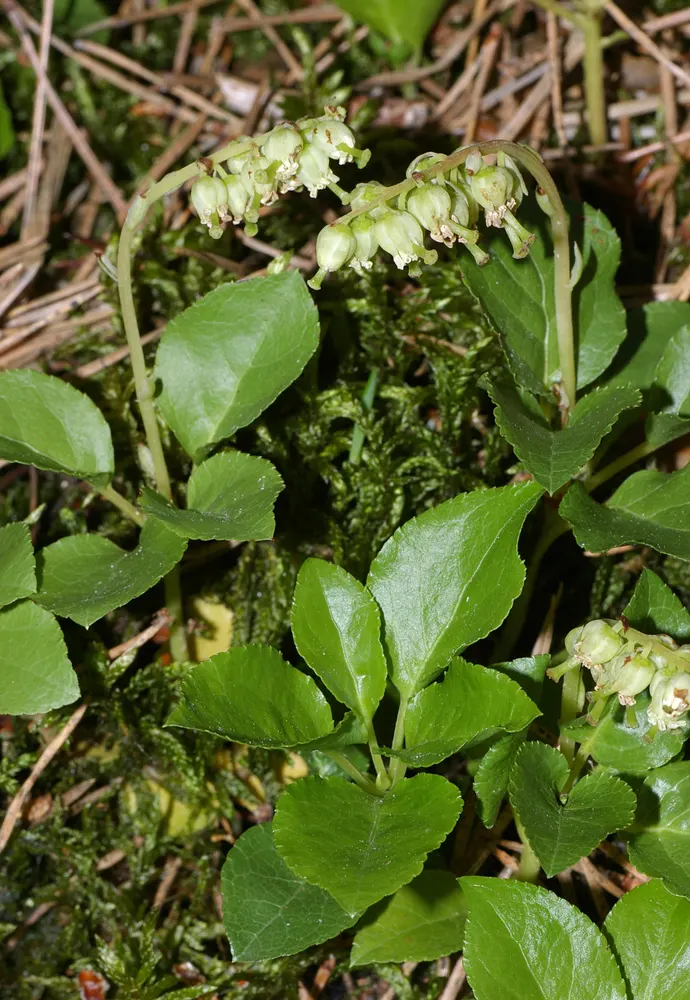
Photo: Christian Fischer, CC BY-SA 3.0 (via Wikimedia Commons)
Sidebells Wintergreen
Orthilia secunda
Also known as Sidebells Wintergreen, One-sided Wintergreen, One-sided Pyrola, Serrated Wintergreen, Nodding Wintergreen
Key benefits
✦Traditional uses
✦Sidebells wintergreen is a quiet little plant of the deep forest floor, easy to miss until its single row of nodding flowers catches the light. Several Indigenous peoples across its range in North America gathered the leaves of this and related woodland wintergreens for washes and poultices applied to minor wounds, sores, and skin irritations, valuing their cooling, astringent quality. It has also traditionally been used, alongside its close cousins the pyrolas, as a mild tea for occasional use as a soothing tonic. Because it grows so slowly and depends on a delicate partnership with forest fungi, it has always been a plant gathered sparingly rather than harvested in quantity.
How to grow & use it
✦The full apothecary for Sidebells Wintergreen
Traditional remedies and step-by-step preparations, a complete growing guide, and how to harvest, dry, and store it, all unlocked with HerbLens Unlimited.
- ✦Remedies & preparations
- ✦ Growing guide
- ✦Harvest & storage
From under $6 a month. Free plant identifications always included.
- ✦Plantain
- ✦Yarrow
- ✦Mullein
- ✦Pyrola (Pyrola species)
- ✦Uva ursi (bearberry)
“For the plant that turns its face away from the sun and toward the shaded, mossy hush of the old forest floor.”
The species name secunda means one-sided in Latin, describing how every flower on the stem turns to face the same direction, a trait so distinctive that both its scientific and common names point to the very same quiet detail.
Related to bearberry and containing arbutin, a compound the body converts to hydroquinone, so it should be used only occasionally, not as a daily tea. Avoid in pregnancy, breastfeeding, and with kidney disease.