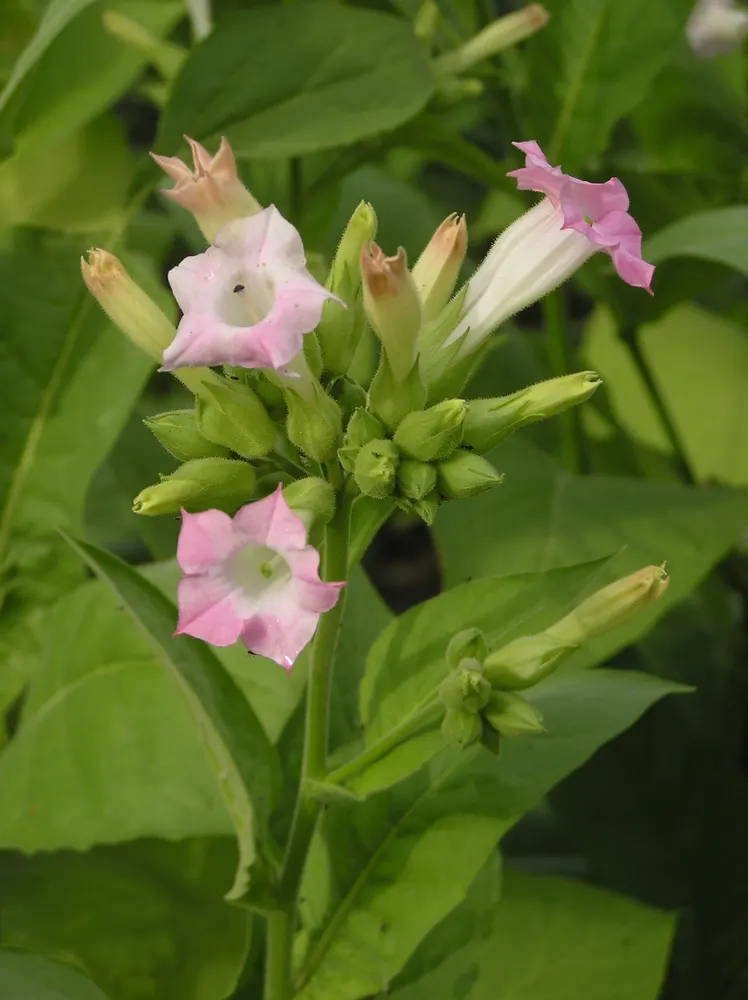
Photo: Jom / Joachim Müllerchen, CC BY 2.5 (via Wikimedia Commons)
Tobacco
Nicotiana tabacum
Also known as Cultivated Tobacco, Virginia Tobacco, Aztec Tobacco
Key benefits
✦Traditional uses
✦Long before it crossed the Atlantic, tobacco held deep ceremonial standing among many Indigenous peoples of the Americas, who grew and smoked it in pipes as an offering, a marker of peace and diplomacy, and a bridge in prayer and healing rituals, treating the plant as sacred rather than casual. European traders carried it back in the sixteenth century, where it was first sold in apothecary shops as a cure-all before its dangers were understood, and it went on to become one of the most heavily traded agricultural crops in history, reshaping economies, labor systems, and entire regions of the American South and Caribbean. That complicated legacy, sacred plant on one hand and a driver of addiction, disease, and the transatlantic slave trade on the other, is part of what makes tobacco such a singular figure in botanical history.
How to grow & use it
✦The full apothecary for Tobacco
Traditional remedies and step-by-step preparations, a complete growing guide, and how to harvest, dry, and store it, all unlocked with HerbLens Unlimited.
- ✦Remedies & preparations
- ✦ Growing guide
- ✦Harvest & storage
From under $6 a month. Free plant identifications always included.
- ✦Marigold, a classic companion for pest deterrence in the tobacco patch
- ✦Basil, often interplanted as a pollinator draw
- ✦Sunflowers, grown historically along field borders
- ✦Nicotiana alata (flowering tobacco), grown as a fragrant, ornamental garden relative without the harvest history of N. tabacum
- ✦Nicotiana sylvestris, another purely ornamental cousin prized for its tall white blooms
“For the gardener curious about the broad, velvety leaf that rerouted continents, economies, and centuries, best admired growing in the bed rather than gathered for the cup.”
The genus Nicotiana, and the nicotine within it, both take their name from Jean Nicot, a sixteenth century French ambassador to Portugal who sent tobacco seeds and leaves back to the French court as a curious new medicinal plant from the Americas.
Tobacco is genuinely dangerous and is not included here as a home remedy plant. Every part of the growing plant is rich in nicotine, an alkaloid that is toxic in fairly small amounts, and simply handling wet tobacco leaves during harvest can cause green tobacco sickness, with nausea, vomiting, and dizziness from nicotine absorbed straight through the skin. Ingesting tobacco leaf, or nicotine in any concentrated form, is a recognized poisoning risk and can be fatal, especially for small children and pets, for whom even a small amount of leaf or a stray cigarette can be a medical emergency. Chewing or smoking cured tobacco is strongly linked to cancers, heart and lung disease, and is highly addictive, and nicotine crosses the placenta and is considered unsafe in pregnancy and while breastfeeding. It can also interact with a range of prescription medications. Grow it, if at all, as a striking heirloom or ornamental garden plant, keep it well away from children and pets, and never prepare it as a tea, tincture, or any other home remedy. If tobacco or nicotine ingestion is ever suspected, contact poison control or emergency services right away, and speak with a qualified medical professional for any questions about tobacco use or cessation.