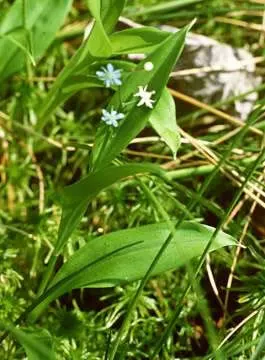
Photo: Unknown authorUnknown author, Public domain (via Wikimedia Commons)
Three-leaf False Solomon's Seal
Maianthemum trifolium
Also known as Three-leaved Solomon's Plume, Bog Solomon's Seal, Three-leaf Solomon's Plume, Smilacina trifolia (older name)
Key benefits
✦Traditional uses
✦Three-leaf false Solomon's seal is a quiet little citizen of the northern bog, easy to miss until its white starred flowers catch the light against a carpet of sphagnum moss. Unlike its larger cousin, Maianthemum racemosum, whose root and berries carried a real place in Native American herbal traditions, this smaller bog-dwelling relative has left little documented trace in ethnobotanical or herbal records. What history it does have belongs less to the medicine chest and more to the field notebook, valued by botanists and bog naturalists as a delicate signal that a wetland is undisturbed and still breathing. Its charm has always been quieter than practical, a small beauty best left rooted where it grows.
How to grow & use it
✦The full apothecary for Three-leaf False Solomon's Seal
Traditional remedies and step-by-step preparations, a complete growing guide, and how to harvest, dry, and store it, all unlocked with HerbLens Unlimited.
- ✦Remedies & preparations
- ✦ Growing guide
- ✦Harvest & storage
From under $6 a month. Free plant identifications always included.
“For the hush of a sphagnum bog in early summer, and small white stars scattered across the moss.”
This little bog dweller was long classified in its own genus, Smilacina, until genetic studies moved it into Maianthemum alongside the lily-of-the-valley's other relatives. Botanists still prize it today as one of several small plants used to gauge whether a peat bog remains ecologically intact.
This plant has no established food or medicinal use, and its berries may cause mild stomach upset if eaten, so it should not be ingested.