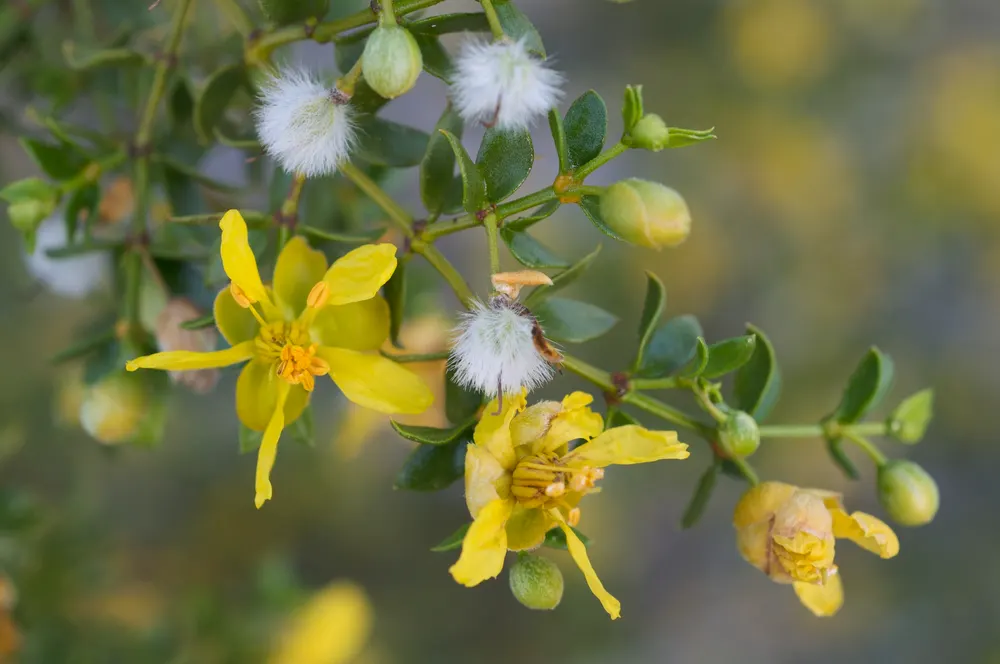
Photo: Eric in SF, CC BY-SA 3.0 (via Wikimedia Commons)
Creosote Bush
Larrea tridentata
Also known as Chaparral, Greasewood, Gobernadora, Hediondilla
Key benefits
✦Traditional uses
✦Long before it had a Latin name, creosote bush was one of the most relied-upon plants of the Sonoran, Mojave, and Chihuahuan deserts. The Tohono O'odham, Akimel O'odham, Cahuilla, and other Southwestern nations gathered its resin-coated leaves and stems to make washes and poultices applied to the skin for cuts, sores, insect bites, and aching joints, and burned or steeped the branches for their sharp, cleansing aroma. The dark resin itself had practical value too, used as a glue and a waterproofing agent for baskets and pottery. It is a plant woven into desert life for thousands of years, valued as much for its resilience as for its uses.
How to grow & use it
✦The full apothecary for Creosote Bush
Traditional remedies and step-by-step preparations, a complete growing guide, and how to harvest, dry, and store it, all unlocked with HerbLens Unlimited.
- ✦Remedies & preparations
- ✦ Growing guide
- ✦Harvest & storage
From under $6 a month. Free plant identifications always included.
- ✦Aloe vera
- ✦Desert lavender
- ✦Jojoba
- ✦Juniper
- ✦Sagebrush
“For the scent of the first desert rain, not for the tea kettle.”
In California's Mojave Desert grows a ring of creosote bush clones nicknamed King Clone, all sprouted from a single ancestor plant. Growth-rate studies estimate the ring is roughly 11,700 years old, making it one of the oldest living organisms on Earth.
Creosote bush, sold in stores as chaparral, carries a real and well-documented risk when taken internally: case reports link ingested chaparral to serious liver injury, including hepatitis and, in rare cases, liver failure requiring transplant. Because of this, the FDA issued a public warning decades ago advising against internal use, and it should not be taken as a tea, tincture, capsule, or any other internal preparation. It should be avoided entirely during pregnancy and breastfeeding, by anyone with existing liver or kidney conditions, and by anyone taking medications processed by the liver. Even topical use has been known to cause allergic skin reactions in sensitive individuals, so a small patch test is wise before broader use. Please talk with a qualified healthcare provider before using this plant in any form.