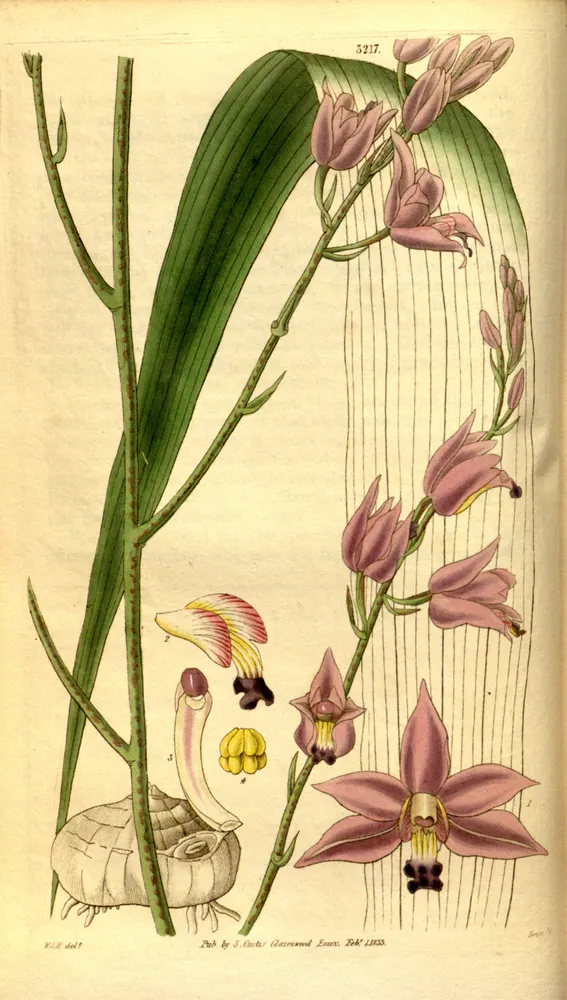
Photo: W. J. H. (= William Jackson Hooker) (1785-1865) del., Swan sc., Public domain (via Wikimedia Commons)
Pine Pink
Bletia purpurea
Also known as Pine Pink Orchid, Purple Bletia, Christmas Orchid
Key benefits
✦Traditional uses
✦Pine pink has never been one of the great herbal remedies of the Americas; it belongs instead to the quieter tradition of the wildflower admired rather than gathered. Naturalists in the pine barrens of Florida and the Caribbean have long noted its habit of blooming in cheerful, unexpected flushes after a fire has swept through the understory, a trait that made it a small, hopeful marker of land renewing itself. Native plant gardeners and orchid collectors have carried that same appreciation into cultivated beds, prizing it as one of the few terrestrial orchids that will actually thrive in an open, sunny garden rather than a shaded greenhouse. Its scientific name honors Luis Blet, an eighteenth century Spanish apothecary, though the plant itself was never a staple of his trade.
How to grow & use it
✦The full apothecary for Pine Pink
Traditional remedies and step-by-step preparations, a complete growing guide, and how to harvest, dry, and store it, all unlocked with HerbLens Unlimited.
- ✦Remedies & preparations
- ✦ Growing guide
- ✦Harvest & storage
From under $6 a month. Free plant identifications always included.
- ✦Blazing star (Liatris)
- ✦Coreopsis
- ✦Wiregrass
- ✦Ladies' tresses (Spiranthes species), another native terrestrial orchid suited to a similar wild garden niche
“For the gardener who dreams of orchids blooming wild in open pine woods, not shut behind glass.”
Unlike most orchids, which sulk if disturbed, pine pink often responds to a passing wildfire by blooming more abundantly the following season, a behavior botanists still find useful as a rough gauge of how recently a pineland has burned.
This orchid has no tradition of food or medicinal use and should not be eaten or brewed. Like most wild orchids it is protected under international trade rules, so buy nursery-propagated plants rather than collecting from the wild.