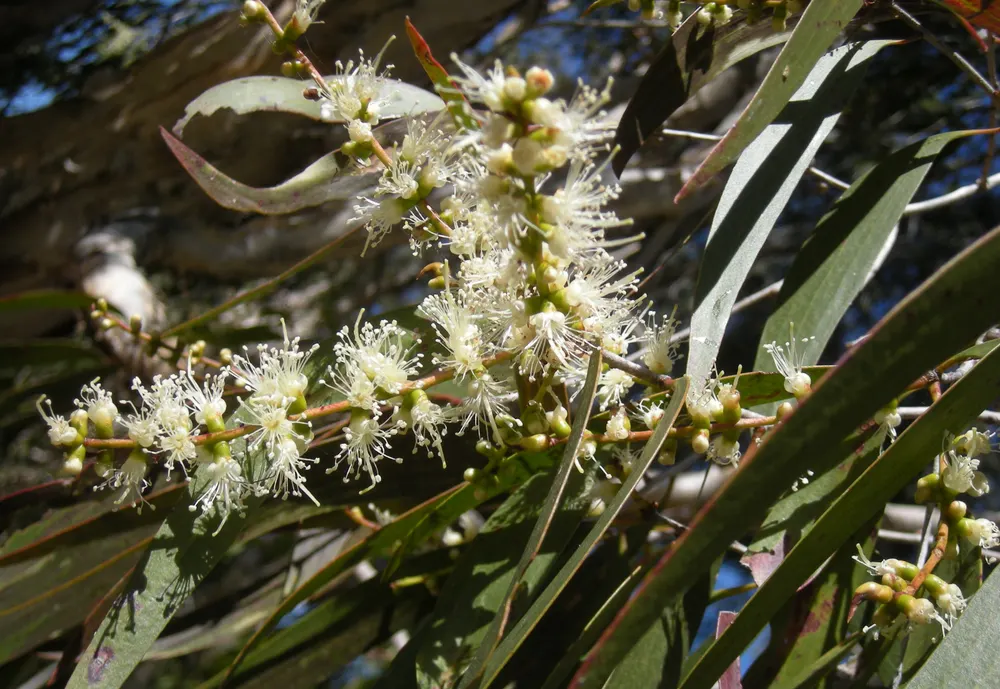
Photo: Ethel Aardvark, CC BY 3.0 (via Wikimedia Commons)
Cajeput Tree
Melaleuca leucadendra
Also known as Weeping Paperbark, Long-leaved Paperbark, Cajuput, White Tea Tree, Punk Tree
Key benefits
✦Traditional uses
✦Long before it had a Latin name, this paperbark tree was already deeply woven into daily life across its native range. Aboriginal Australian communities peeled its soft, papery bark in wide sheets to wrap food for cooking in the coals, to line shelters, and even to fashion canoes and bedding. In Malaysia and Indonesia, where the tree takes its common name from the Malay 'kayu putih,' meaning white wood, its leaves were steam-distilled into a sharp, camphor-scented oil that traveled the spice routes and became a household remedy from Java to the Philippines. That oil, cajeput, was traditionally rubbed on aching joints, dabbed on the chest for stuffy colds, and burned or diffused to freshen sickrooms, and it eventually made its way into European medicine cabinets by the eighteenth century as one of the first Australasian botanicals to gain a following abroad.
How to grow & use it
✦The full apothecary for Cajeput Tree
Traditional remedies and step-by-step preparations, a complete growing guide, and how to harvest, dry, and store it, all unlocked with HerbLens Unlimited.
- ✦Remedies & preparations
- ✦ Growing guide
- ✦Harvest & storage
From under $6 a month. Free plant identifications always included.
- ✦Eucalyptus
- ✦Tea Tree
- ✦Ginger
- ✦Tea Tree oil
- ✦Eucalyptus oil
“For a breath of sharp, clearing green when a cold has settled into the chest.”
The tree's papery, pale bark peels away in thin, ghostly sheets, which is exactly what earned it the Malay name 'kayu putih,' or white wood, the very word that became 'cajeput' once European traders carried the oil home.
Cajeput essential oil is for external use only; swallowing it can be toxic, especially for children. Always dilute in a carrier oil before skin use, patch test first, and avoid applying near the face of infants and young children.