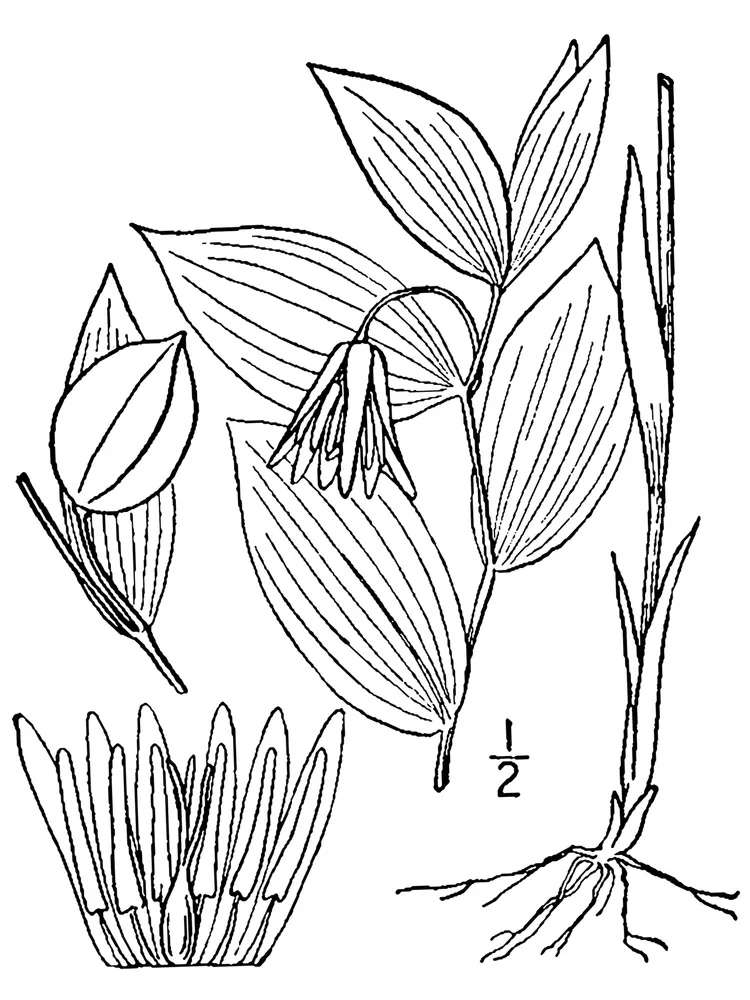
Photo: Britton, N.L., and A. Brown. 1913. An illustrated flora of the northern United States, Canada and the British Possessions. 3 vols. Charles Scribner's Sons, New York. Vol. 1: 519. Courtesy of Kentucky Native Plant Society. Scanned by Omnitek Inc., Public domain (via Wikimedia Commons)
Mountain Bellwort
Uvularia puberula
Also known as Downy Bellwort, Southern Bellwort, Mountain Merrybells
Key benefits
✦Traditional uses
✦Mountain bellwort grows quietly along the shaded slopes of the southern Appalachians, its nodding pale flowers among the first small signs that the forest floor is waking each spring. Other members of the bellwort family have a longer folk history, their roots said to have been used in poultices and throat remedies by some Appalachian and Cherokee herbalists, but specific historical records for this particular species are thin, and its traditions have not been passed down with the same detail as its showier cousins. Mountain bellwort has remained, above all, a plant of quiet woodland appreciation rather than the apothecary shelf, treasured today chiefly by native plant gardeners and wildflower walkers who prize its understated grace.
How to grow & use it
✦The full apothecary for Mountain Bellwort
Traditional remedies and step-by-step preparations, a complete growing guide, and how to harvest, dry, and store it, all unlocked with HerbLens Unlimited.
- ✦Remedies & preparations
- ✦ Growing guide
- ✦Harvest & storage
From under $6 a month. Free plant identifications always included.
- ✦Solomon's seal
- ✦Wild ginger
- ✦Trillium
- ✦Solomon's seal (Polygonatum biflorum)
- ✦Trout lily (Erythronium americanum)
“For the hush of a spring woodland, before the canopy closes overhead.”
The genus name Uvularia comes from the Latin uvula, because the dangling, tubular flowers reminded early botanists of the little fleshy piece at the back of the throat, a resemblance that once led practitioners of the old doctrine of signatures to reach for bellwort root when treating throat complaints.
No reliable safety data exists for ingesting mountain bellwort, and its family includes genuinely toxic plants like autumn crocus, so it shouldn't be eaten or assumed safe based on resemblance to other bellworts.