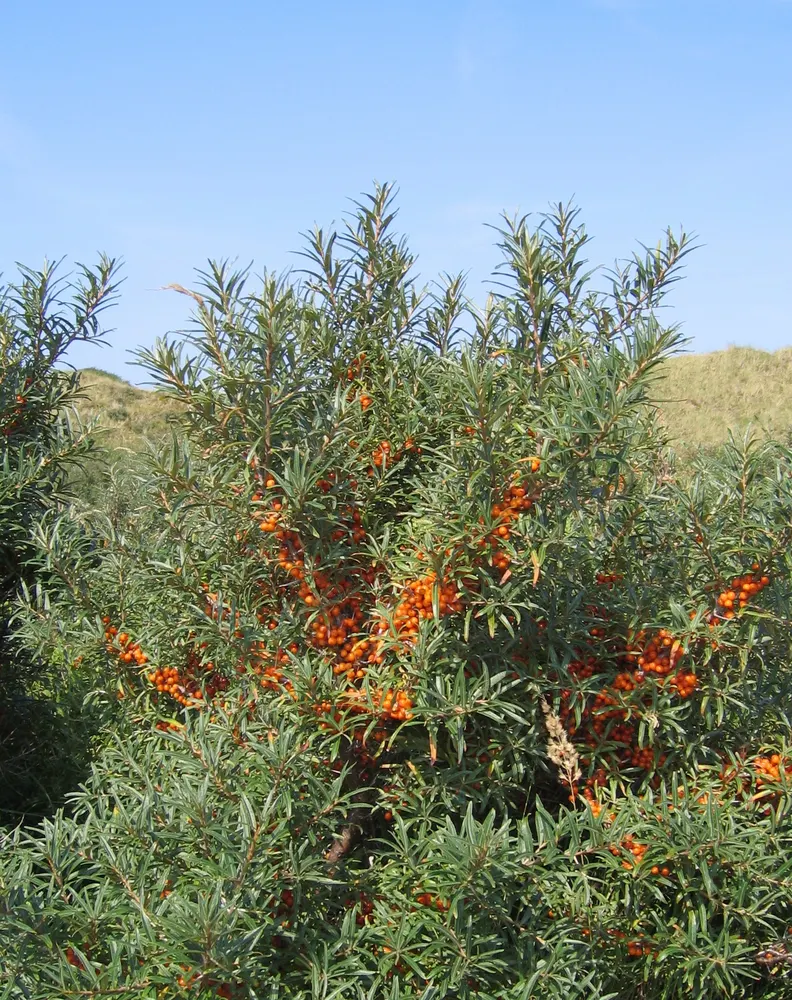
Photo: No machine-readable author provided. Svdmolen assumed (based on copyright claims)., CC BY-SA 3.0 (via Wikimedia Commons)
Sea Buckthorn
Hippophae rhamnoides
Also known as Seaberry, Sallowthorn, Siberian Pineapple, Sandthorn
Key benefits
✦Traditional uses
✦Sea buckthorn has a long history stretching from Tibetan and Mongolian medicine to ancient Greek horse pastures, where its leaves and berries were said to be fed to horses to give their coats a brilliant shine, which is where the genus name Hippophae, meaning shining horse, comes from. Along the coasts and river valleys of Europe and Asia, the tart orange berries were traditionally pressed into juices and preserves to help see families through the cold, dark months. Herbalists in the regions where it grows wild also turned to the oil pressed from its pulp and seeds as a traditional skin salve. Its ability to thrive in poor, windswept, sandy soil made it as prized for stabilizing eroding land as for the berries themselves.
How to grow & use it
✦The full apothecary for Sea Buckthorn
Traditional remedies and step-by-step preparations, a complete growing guide, and how to harvest, dry, and store it, all unlocked with HerbLens Unlimited.
- ✦Remedies & preparations
- ✦ Growing guide
- ✦Harvest & storage
From under $6 a month. Free plant identifications always included.
- ✦Rosehip
- ✦Ginger
- ✦Honey
- ✦Rosehip
- ✦Elderberry
“When the season turns cold and you want a bright, tart burst of orange sunshine steeped into your cup.”
The genus name Hippophae comes from the Greek for shining horse, since ancient Greek horse breeders reportedly fed the leaves and berries to their animals to give their coats a glossy sheen, a practice some historians link to the legend of the winged horse Pegasus.
The berries and juice are a gentle, widely eaten food, though they're quite acidic and may irritate a sensitive stomach in excess. Concentrated oil or extracts have mild blood-thinning and blood-pressure-lowering effects, so use caution with anticoagulant or blood pressure medication, or before surgery.