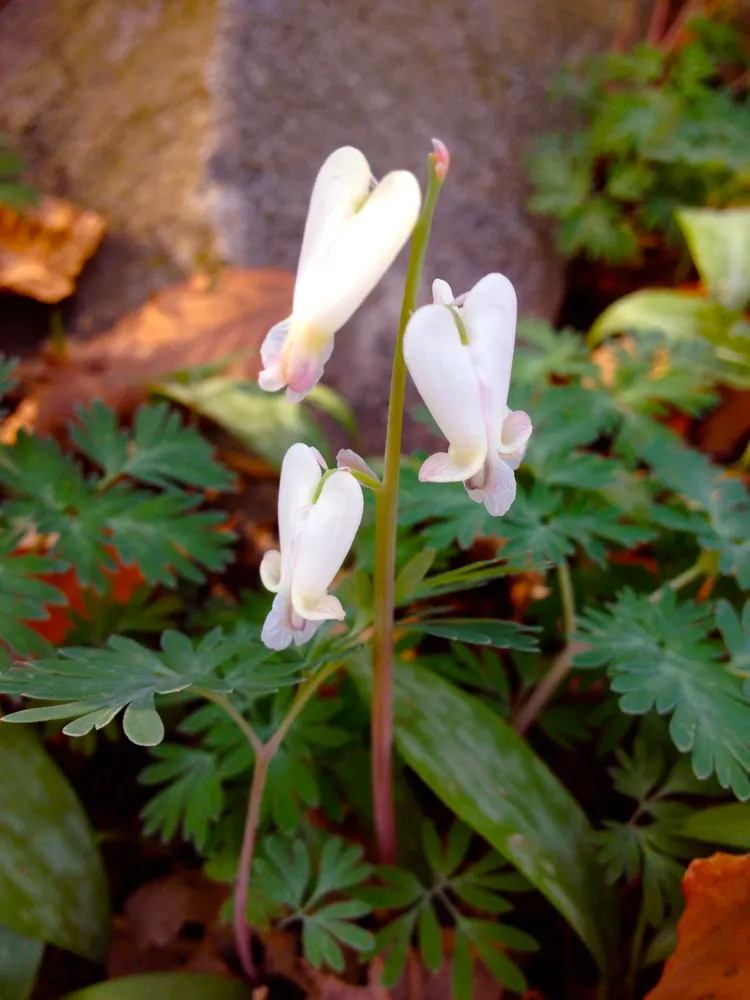
Photo: Fritzflohrreynolds, CC BY-SA 3.0 (via Wikimedia Commons)
Squirrel Corn
Dicentra canadensis
Key benefits
✦Traditional uses
✦Squirrel corn was never a plant early American herbalists reached for as medicine, and for good reason. Nineteenth-century physicians and botanists who catalogued it, including the Eclectic doctors who prized so many of its woodland neighbors, noted its narcotic and irritant properties and generally steered clear, cataloguing it as a curiosity and a danger to grazing stock rather than a remedy. What earned it a place in folk memory instead was its charming underground architecture, clusters of small golden tubers that farmers and foragers likened to kernels of corn, and the plant's habit of vanishing back into the earth by early summer as if it had never bloomed at all. Its real legacy is as a beloved spring ephemeral, one of the first hushed announcements that the forest floor is waking up.
How to grow & use it
✦The full apothecary for Squirrel Corn
Traditional remedies and step-by-step preparations, a complete growing guide, and how to harvest, dry, and store it, all unlocked with HerbLens Unlimited.
- ✦Remedies & preparations
- ✦ Growing guide
- ✦Harvest & storage
From under $6 a month. Free plant identifications always included.
- ✦Dutchman's breeches
- ✦Trillium
- ✦Wild ginger
- ✦Dutchman's breeches (visually similar spring ephemeral, equally not for internal use)
“For the woodland shade garden that wants a hushed, fleeting week of heart-shaped white blooms, not for the medicine cabinet.”
Squirrel corn gets both its common name and its old folk name, staggerweed, from real observation: squirrels were seen digging up and caching its little yellow tuber clusters, which look uncannily like kernels of corn, while free-ranging cattle that grazed on the plant were sometimes seen stumbling and trembling, giving rise to a name early farmers used as a warning as much as a description.
Squirrel corn is toxic, not a culinary or medicinal herb. Every part of the plant, especially its small yellow corn-kernel-like tubers, contains isoquinoline alkaloids (including protopine and related compounds shared with its close relative Dutchman's breeches) that can cause trembling, staggering, labored breathing, and convulsions if ingested, a syndrome old-time farmers called "the staggers" when livestock grazed on it. It is also known to cause skin irritation or contact dermatitis in some people who handle the foliage. Do not eat, brew, or apply any part of this plant, and keep grazing animals, pets, and children away from patches in the garden or the woods. If you or an animal in your care has eaten any part of this plant, contact a poison control center, veterinarian, or physician right away rather than attempting a home remedy.