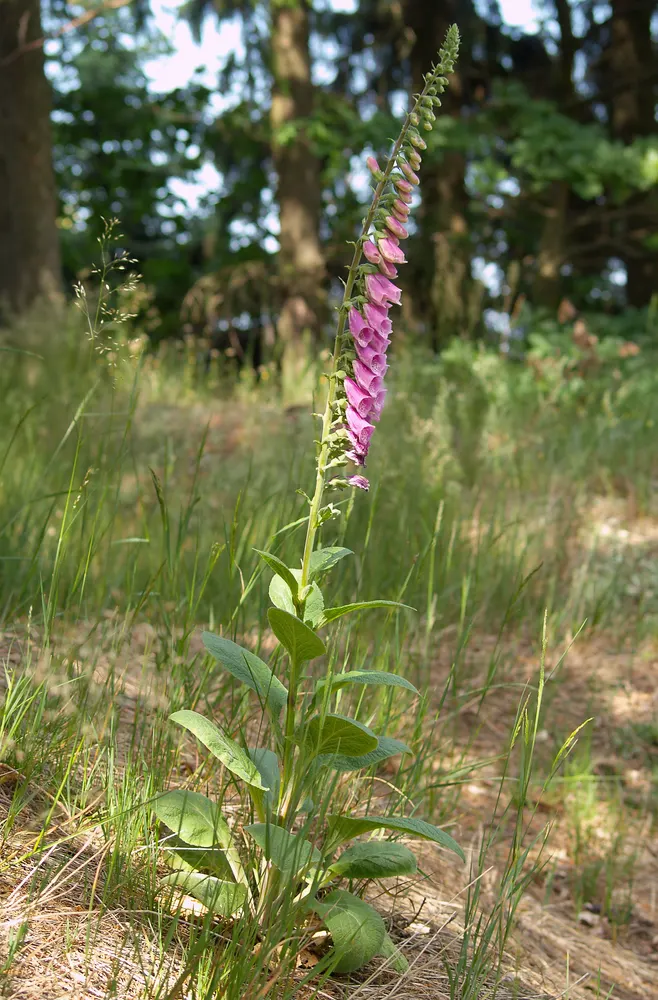
Photo: Jörg Hempel, CC BY-SA 3.0 de (via Wikimedia Commons)
Foxglove
Digitalis purpurea
Also known as Lady's Glove, Fairy Bells, Witches' Gloves, Dead Man's Bells, Fairy Thimbles
Key benefits
✦Traditional uses
✦Long before it entered a medicine bottle, foxglove grew wild along the hedgerows and woodland edges of Europe, where country folk both revered and feared its tall, speckled spires. Welsh and English herbalists used it in folk poultices and heart tonics for centuries, though its narrow line between remedy and poison made it a risky, often deadly, tradition. Its true turning point came in 1785, when the English physician William Withering published his landmark study on foxglove after learning of an old Shropshire woman's secret herbal recipe for dropsy (what we now call heart failure caused by fluid buildup), and identified foxglove as the effective ingredient. That discovery led directly to digoxin, a heart medication still prescribed by cardiologists today, making foxglove one of the rare wild plants that reshaped modern pharmacology entirely.
How to grow & use it
✦The full apothecary for Foxglove
Traditional remedies and step-by-step preparations, a complete growing guide, and how to harvest, dry, and store it, all unlocked with HerbLens Unlimited.
- ✦Remedies & preparations
- ✦ Growing guide
- ✦Harvest & storage
From under $6 a month. Free plant identifications always included.
- ✦Hollyhock
- ✦Delphinium
- ✦Lupine
- ✦Hawthorn (Crataegus species), traditionally used for gentle, long-term heart and circulatory support under professional guidance
“For the gardener who wants towering spires of color and pollinators humming at every bloom, and an appreciation for the wild plant whose secrets, once decoded, changed how medicine treats the human heart.”
The name Digitalis comes from the Latin digitus, meaning finger, because each tubular flower fits perfectly over a fingertip, and this same finger-like shape is likely behind the plant's old folk name, fairy gloves, said to be worn by mischievous woodland spirits.
Every part of foxglove, root, leaf, flower, and seed, is genuinely poisonous, and this is not a plant to taste, brew, or self-treat with under any circumstances. It contains potent cardiac glycosides (including digoxin and digitoxin) that disrupt the heart's electrical rhythm, and ingestion can cause nausea, vomiting, visual disturbances (including the yellow-green halos famously described by Van Gogh), dangerously irregular heartbeat, seizures, and death, sometimes from a dose as small as a mouthful of leaf mistaken for comfrey or borage. It is especially dangerous for children, pregnant people, and anyone on heart medication, diuretics, or blood pressure drugs, and it is highly toxic to dogs, cats, and livestock as well. Even handling the plant can irritate sensitive skin, so gardeners are wise to wear gloves. Foxglove's compounds are still used in modern medicine, but only as precisely measured pharmaceutical drugs prepared and prescribed by physicians, never as a home remedy. If you or a pet may have ingested any part of this plant, contact Poison Control or a veterinarian immediately, and always consult a qualified healthcare professional before using any plant medicinally.