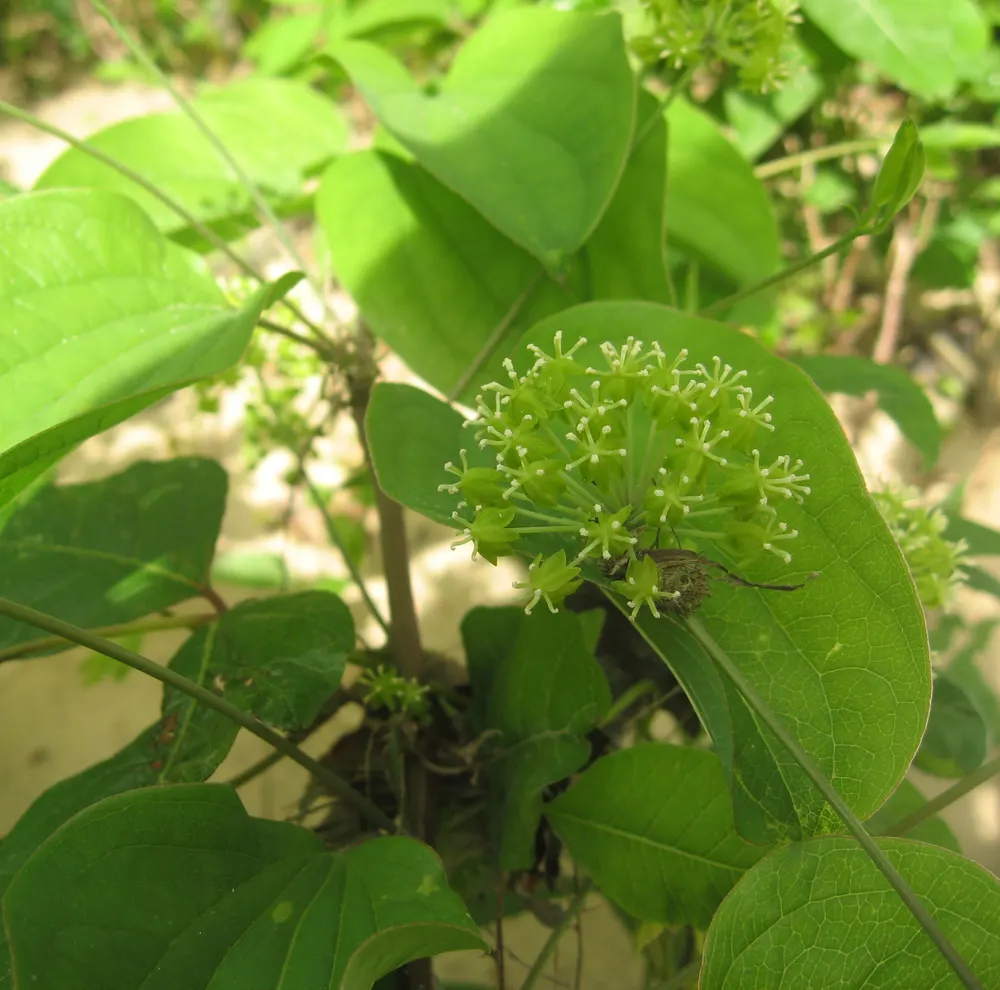
Photo: Mason Brock (Masebrock), Public domain (via Wikimedia Commons)
Carrion Flower
Smilax herbacea
Also known as Carrion flower, Smooth carrionflower, Eastern carrionflower
Key benefits
✦Traditional uses
✦Long before it had a tidy common name, this scrambling woodland vine was known to Native peoples of the eastern forests as a useful, unassuming neighbor. Its roots were dug, pounded, and washed to yield a starchy paste used much like the roots of its greenbrier relatives, thickening soups or setting into a simple jelly in lean seasons. Herbalists working in the broader Smilax tradition, the same family that gave the world true sarsaparilla, sometimes turned carrion flower's roots into a mild tonic tea, taken as a gentle spring cleanse after a long winter of heavier, stored food. The tender young shoots, meanwhile, were simply eaten fresh, snapped off and cooked like a wild, delicately bitter asparagus.
How to grow & use it
✦The full apothecary for Carrion Flower
Traditional remedies and step-by-step preparations, a complete growing guide, and how to harvest, dry, and store it, all unlocked with HerbLens Unlimited.
- ✦Remedies & preparations
- ✦ Growing guide
- ✦Harvest & storage
From under $6 a month. Free plant identifications always included.
- ✦True sarsaparilla
- ✦Burdock root
- ✦Sassafras
- ✦True sarsaparilla (Smilax ornata or Smilax officinalis)
- ✦Burdock root
“For the forager who spots a tangle of curling tendrils along the woodland edge and wonders what the old cooks and root diggers once made of it.”
Carrion flower earns its unappetizing name honestly: its greenish-yellow blooms give off a faint whiff of rotting meat, a clever trick to lure flies and carrion beetles in as pollinators instead of the bees and butterflies most flowers court.
No significant toxicity is known, and its young shoots have long been eaten as a trail nibble, though correct identification matters since it grows tangled among other woodland vines.