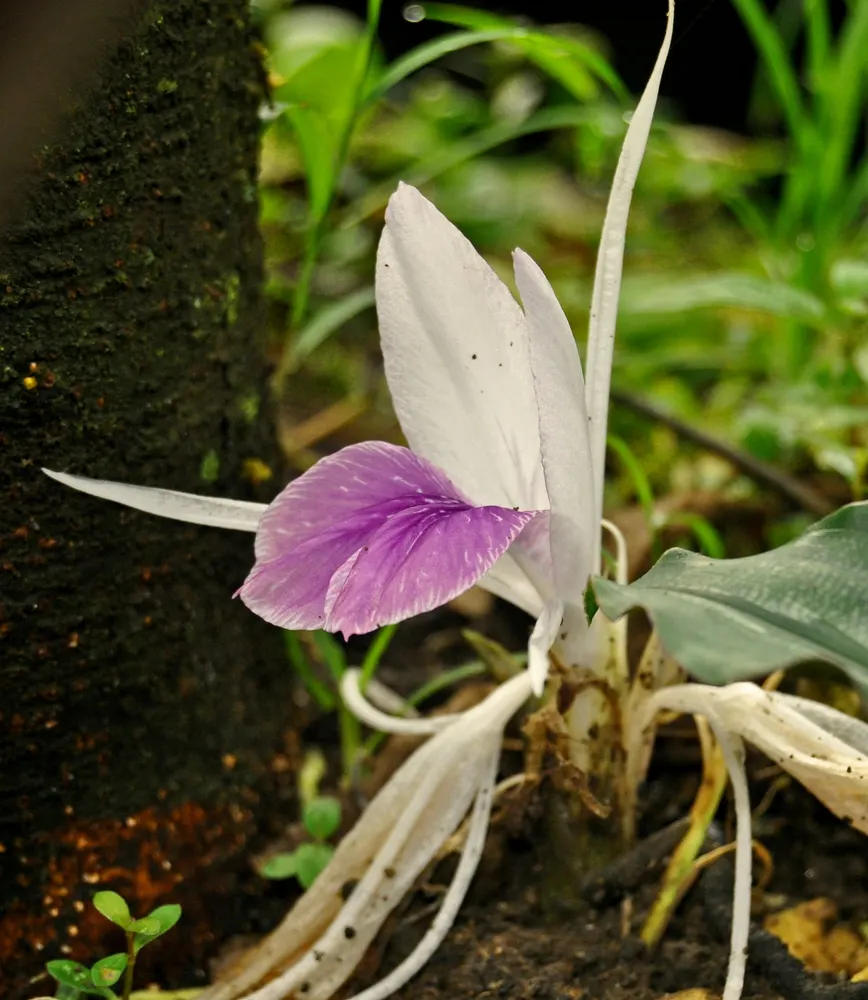
Photo: Wibowo Djatmiko (Wie146), CC BY-SA 3.0 (via Wikimedia Commons)
Resurrection Lily
Kaempferia rotunda
Also known as Peacock Ginger, Indian Crocus, Round-rooted Galangal, Bhui Champa, Hidden Ginger
Key benefits
✦Traditional uses
✦Long before it had a name in Western gardens, the round rhizome of Kaempferia rotunda was already a fixture of the village apothecary shelf across India and Southeast Asia. In Ayurveda, healers folded it into tonic formulations meant to warm the body and settle the stomach, and pounded the fresh root into a paste to lay over bruises, swellings, and slow-healing wounds. In Indonesia, it is a cornerstone of jamu, the traditional tonic given to women after childbirth and prized by younger women as a beauty aid for the skin. The plant earned its common name because its flowers seem to rise straight out of bare earth each spring, blooming before a single leaf appears, as though the ground itself were coming back to life.
How to grow & use it
✦The full apothecary for Resurrection Lily
Traditional remedies and step-by-step preparations, a complete growing guide, and how to harvest, dry, and store it, all unlocked with HerbLens Unlimited.
- ✦Remedies & preparations
- ✦ Growing guide
- ✦Harvest & storage
From under $6 a month. Free plant identifications always included.
- ✦Ginger
- ✦Turmeric
- ✦Galangal
- ✦Kaempferia galanga (sand ginger)
- ✦Turmeric
“For the garden that seems to bloom straight out of bare earth, and the root steeped in generations of tonic tradition.”
On the island of Java, this humble rhizome was traditionally given not just to people but to elephants, dosed as a folk medicine for the working animals of the region.
Large internal amounts of the rhizome may cause digestive upset, and topical use may irritate sensitive skin, so patch-test first. It's traditionally avoided during pregnancy itself, though used afterward in some traditions.