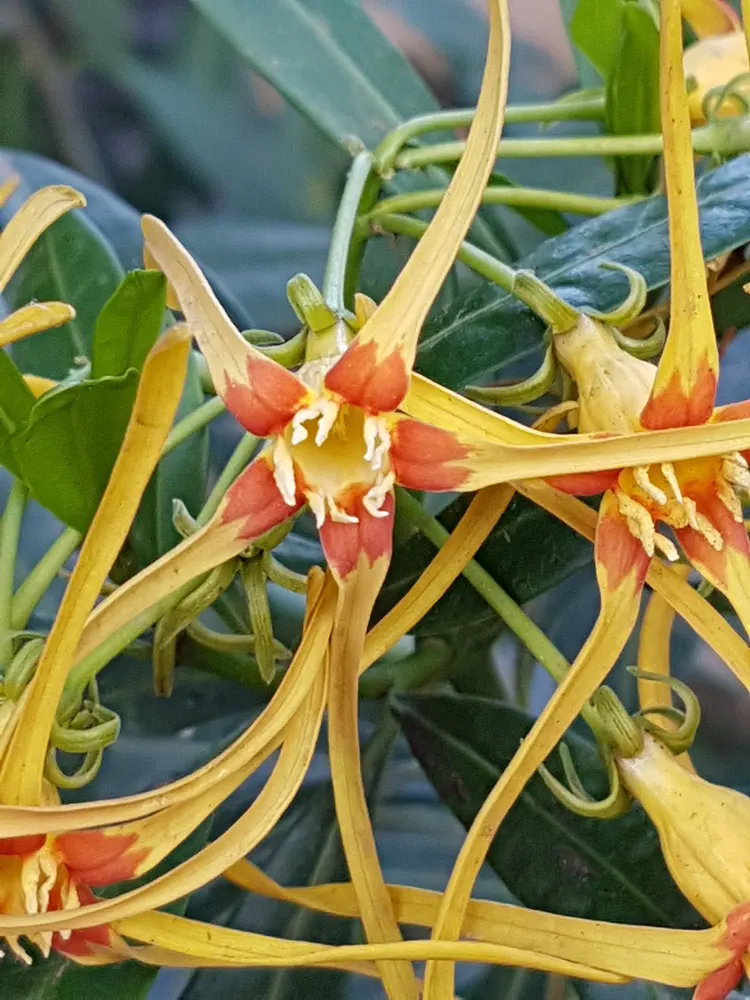
Photo: Paul venter, CC BY-SA 4.0 (via Wikimedia Commons)
Poison Rope
Strophanthus speciosus
Also known as Corky-Bark Poison-Rope, Gifklimop (Afrikaans)
Key benefits
✦Traditional uses
✦Strophanthus speciosus belongs to a genus long known across southern and central Africa for one purpose above all others, arming hunting arrows. Communities in the plant's native range traditionally scraped and boiled the seeds and stem sap into a thick paste applied to arrow tips, a preparation potent enough to bring down large game through its effect on the heart. It was this same family of compounds, cardiac glycosides, that later drew the attention of Western pharmacology, which studied related Strophanthus species to understand how such plant poisons acted on the human heart. Within its own ecosystem, though, the plant's more visible legacy is horticultural, its twisting, streamer-like flowers have long made it a striking, if little-known, addition to gardens that can accommodate its toxicity safely.
How to grow & use it
✦The full apothecary for Poison Rope
Traditional remedies and step-by-step preparations, a complete growing guide, and how to harvest, dry, and store it, all unlocked with HerbLens Unlimited.
- ✦Remedies & preparations
- ✦ Growing guide
- ✦Harvest & storage
From under $6 a month. Free plant identifications always included.
“For a garden that wants breathtaking, twisted blooms and a story about survival, not a remedy for the medicine cabinet.”
The genus name Strophanthus comes from the Greek strophos, meaning twisted cord, and anthos, meaning flower, a direct nod to the long, ribbon-like corolla lobes that spiral out from each bloom like tiny streamers caught in the wind.
Every part of Strophanthus speciosus, especially the seeds and the milky sap, contains potent cardiac glycosides (cardenolides) closely related to those in foxglove and oleander. Southern African hunters traditionally smeared crushed seeds and stem sap onto arrow tips precisely because these compounds are strong enough to stop a heart. Ingesting any part of this plant can cause dangerous arrhythmias, nausea, and potentially fatal cardiac collapse, and there is no traditional dose that is considered safe for eating or brewing. Sap can also irritate skin and eyes on contact, so gloves are wise when pruning or handling seed pods. Keep it well away from children, pets, and livestock, never attempt a home tea, tincture, or poultice from this species, and if you suspect any exposure or ingestion, treat it as a medical emergency and seek help from a qualified professional or poison control immediately.