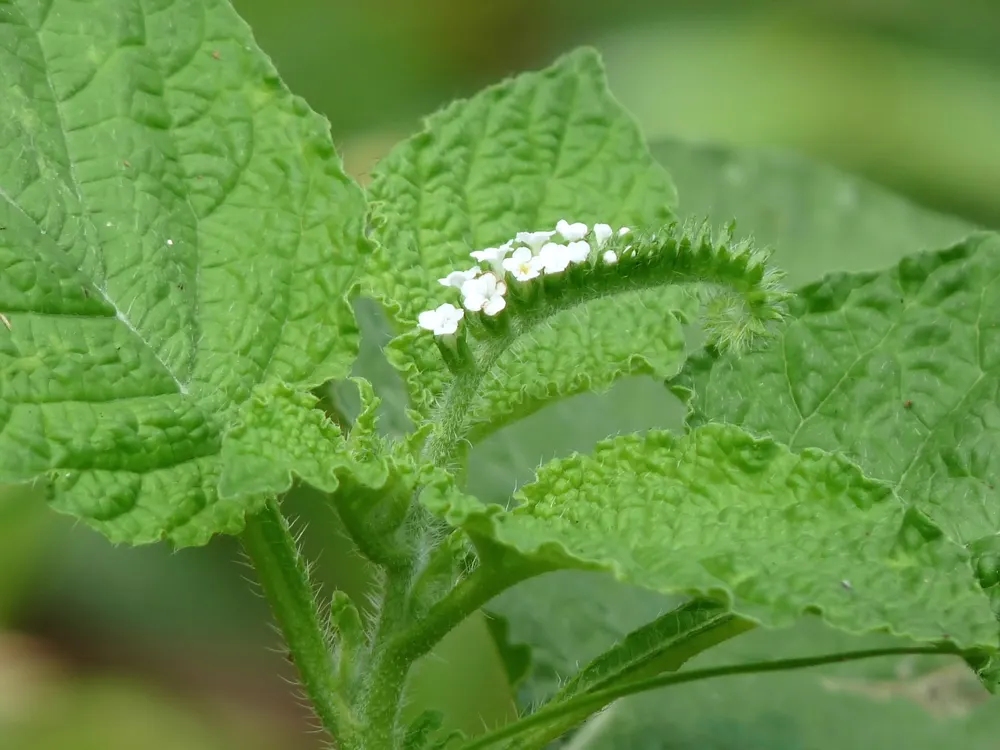
Photo: Jeevan Jose, Kerala, India, CC BY-SA 4.0 (via Wikimedia Commons)
Indian Heliotrope
Heliotropium indicum
Also known as Indian Turnsole, Scorpion Weed, Cocklebur Heliotrope, Otanjele, Hen's Foot
Key benefits
✦Traditional uses
✦Across West Africa, South Asia, and parts of the Caribbean, Indian heliotrope has long been a dooryard weed pressed into folk service for boils, wounds, and insect or scorpion stings, its curled flower spike said to resemble a scorpion's tail, which likely earned it the name scorpion weed under the old doctrine of signatures. Healers crushed the fresh leaves into poultices for skin sores and applied the juice to sting sites, while decoctions were used externally for sore throats and inflamed skin. It appears in traditional Yoruba, Ayurvedic, and Chinese folk medicine records, though always as a plant handled with caution rather than a kitchen-shelf staple. Modern phytochemists have since taken a serious interest in the plant, not for home remedies, but because its unusual alkaloids, including indicine N-oxide, were investigated in mid-twentieth-century cancer research.
How to grow & use it
✦The full apothecary for Indian Heliotrope
Traditional remedies and step-by-step preparations, a complete growing guide, and how to harvest, dry, and store it, all unlocked with HerbLens Unlimited.
- ✦Remedies & preparations
- ✦ Growing guide
- ✦Harvest & storage
From under $6 a month. Free plant identifications always included.
- ✦Calendula, for traditional external wound and skin care
- ✦Plantain leaf, for traditional poultices on stings and bites
“A plant for the field notebook and the wild-edge walk, admired for its odd curled blossom and old folklore, not for the medicine cabinet.”
Indicine N-oxide, one of the pyrrolizidine alkaloids that makes this plant risky to ingest, was pulled from Heliotropium indicum and actually carried into human cancer clinical trials in the 1980s, a strange twist for a roadside weed folk healers once matched to scorpion stings by the curl of its flower spike alone.
Indian heliotrope contains hepatotoxic pyrrolizidine alkaloids, including indicine and lindelofine, the same class of compounds responsible for serious, sometimes fatal liver damage (hepatic veno-occlusive disease) linked to other Heliotropium and Boraginaceae plants in documented poisoning outbreaks. It should not be brewed as a tea, taken internally, or given to children, pregnant or breastfeeding women, or anyone with liver concerns, and even traditional topical use warrants caution since absorption through broken skin is possible. This entry is included for botanical and historical interest only. Please consult a qualified healthcare provider before using any part of this plant, and do not attempt home ingestion.