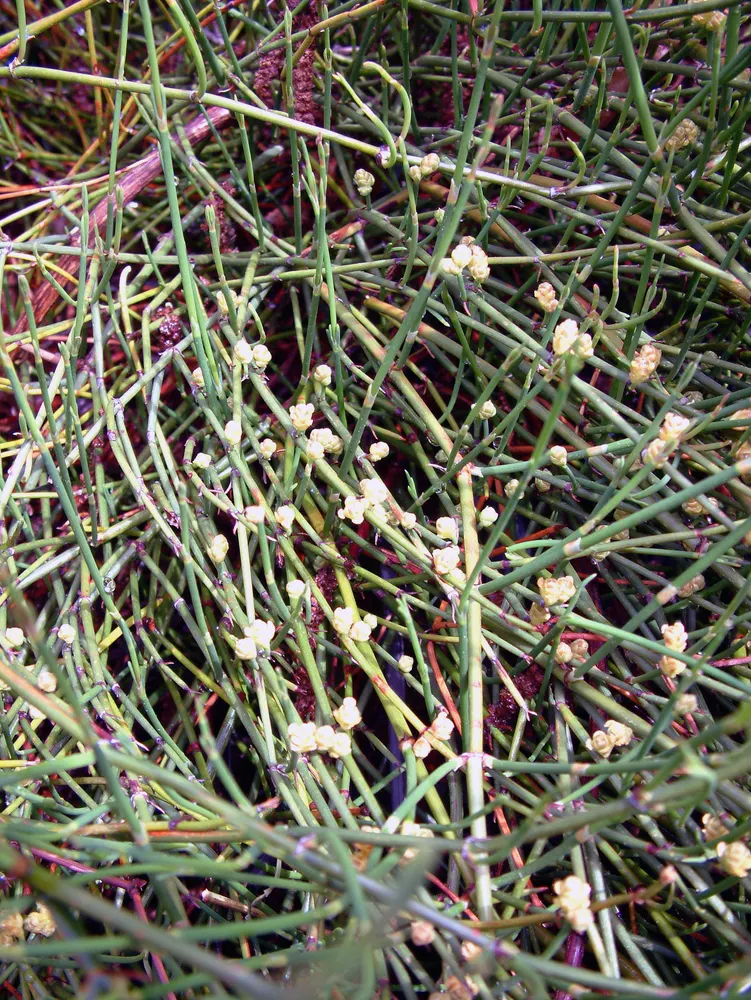
Photo: alexlomas on Flickr, CC BY 2.0 (via Wikimedia Commons)
Ma Huang (Chinese Ephedra)
Ephedra sinica
Also known as Ma Huang, Chinese Ephedra, Desert Herb, Joint Fir
Traditional uses
✦Ma huang has one of the longest continuous records of use in Chinese herbal medicine, appearing in texts going back roughly two thousand years, where dried stem fragments were combined with other herbs under close practitioner supervision for short-term respiratory complaints. It grew wild across the sandy, wind-scoured steppes of the north, a wiry, almost leafless little shrub that early physicians came to recognize by its jointed, bamboo-like stems long before its chemistry was understood. Its most famous constituent, ephedrine, was first isolated from this very plant in the early twentieth century, and that discovery reshaped modern pharmacology and the study of the nervous system far beyond herbalism. That same potency is exactly why this plant demands enormous respect rather than casual use.
How to grow & use it
✦The full apothecary for Ma Huang (Chinese Ephedra)
Traditional remedies and step-by-step preparations, a complete growing guide, and how to harvest, dry, and store it, all unlocked with HerbLens Unlimited.
- ✦Remedies & preparations
- ✦ Growing guide
- ✦Harvest & storage
From under $6 a month. Free plant identifications always included.
- ✦Licorice root (in classical formula pairings, under professional guidance)
- ✦Cinnamon twig (traditional formula companion)
- ✦Elecampane (for traditional respiratory support, non-stimulant)
- ✦Thyme (for traditional respiratory support, non-stimulant)
“A plant to admire from a careful distance, its story written in botany and pharmacology books rather than in a home tea cup.”
Ephedra sinica gave modern medicine its first plant-derived decongestant compound, ephedrine, isolated by the chemist Chen Ko Kuei and colleagues in the 1920s, a discovery that helped launch the entire field of adrenergic pharmacology and eventually led, decades later, to synthetic pseudoephedrine sitting on pharmacy shelves.
Ephedra sinica contains ephedrine and related alkaloids that stimulate the heart and nervous system, and it is genuinely dangerous when self-administered. It has been linked to serious cardiovascular events including rapid heartbeat, dangerously elevated blood pressure, heart attack, stroke, seizures, and death, especially at higher doses, with prolonged use, or combined with caffeine, stimulant medications, or MAOI antidepressants. Because of these risks, the United States FDA banned ephedra-containing dietary supplements in 2004, and the plant and its extracts remain tightly restricted or prohibited in many countries. It is not appropriate during pregnancy or breastfeeding, for anyone with heart disease, high blood pressure, thyroid disorders, anxiety disorders, or glaucoma, and it interacts dangerously with numerous medications. This entry is provided for historical and botanical interest only; no preparation or dosage is given here, and any traditional use of this plant should only ever be considered under the direct supervision of a licensed practitioner experienced in its use, never on your own.