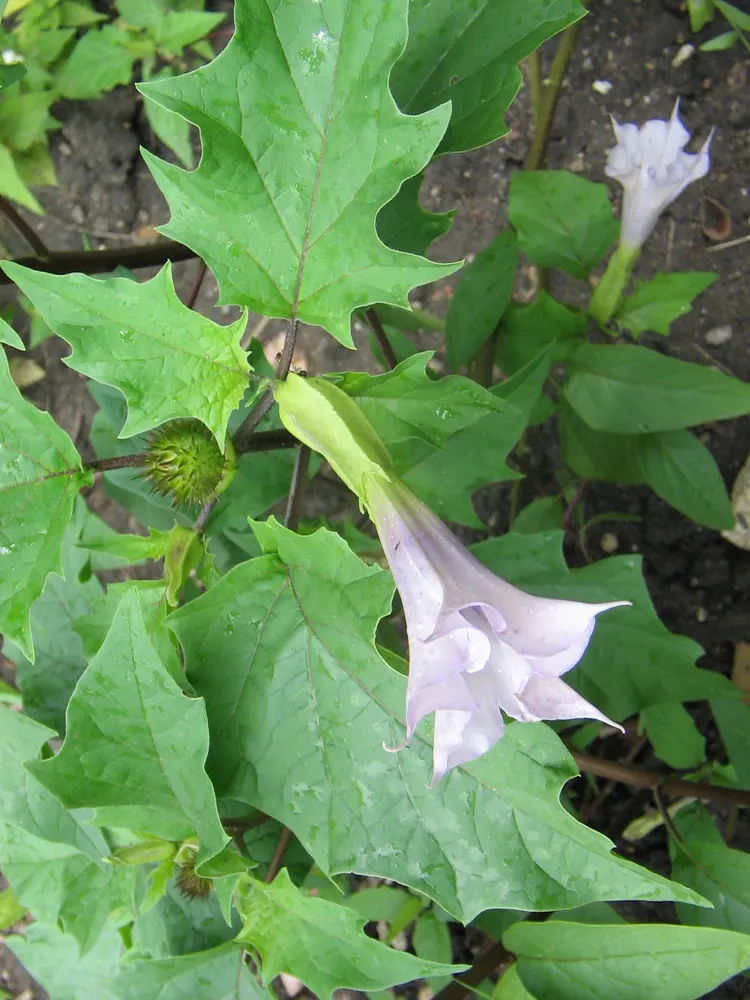
Photo: No machine-readable author provided. Taka assumed (based on copyright claims)., CC BY-SA 3.0 (via Wikimedia Commons)
Jimsonweed
Datura stramonium
Also known as Thorn Apple, Devil's Snare, Devil's Trumpet, Jamestown Weed, Stinkweed
Key benefits
✦Traditional uses
✦Datura stramonium has walked a long, uneasy line between medicine and menace for centuries. Various Indigenous peoples of the Americas incorporated it into closely guarded ceremonial and healing traditions, most famously as toloache in parts of Mexico and the American Southwest, always prepared by specialists who understood its dangers intimately. In nineteenth and early twentieth century Western medicine, dried datura leaves were rolled into cigarettes and burned to ease asthma attacks, and the plant's alkaloids were eventually isolated to create scopolamine and atropine, compounds still used in conventional medicine today for motion sickness, eye exams, and anesthesia premedication, though always in carefully measured pharmaceutical doses rather than the raw plant. The common name jimsonweed itself comes from a 1676 incident in Jamestown, Virginia, when British soldiers ate the plant in a salad and spent eleven days in a documented, bewildering delirium.
How to grow & use it
✦The full apothecary for Jimsonweed
Traditional remedies and step-by-step preparations, a complete growing guide, and how to harvest, dry, and store it, all unlocked with HerbLens Unlimited.
- ✦Remedies & preparations
- ✦ Growing guide
- ✦Harvest & storage
From under $6 a month. Free plant identifications always included.
- ✦Often confused in the field with Datura inoxia and Brugmansia species, other nightshade-family plants that share its trumpet-shaped flowers and toxicity
- ✦Frequently discussed alongside henbane and belladonna as classic tropane-alkaloid plants of herbal history
- ✦Mullein, traditionally used for respiratory comfort in a far gentler and safer way
- ✦Thyme, a common, food-safe herb for supporting easy breathing
“A plant to recognize, respect, and walk past, not one to gather.”
The name jimsonweed is a contraction of Jamestown weed, coined after the 1676 episode in which soldiers sent to quell Bacon's Rebellion unknowingly ate the plant and reportedly spent eleven days blowing feathers, kissing furniture, and behaving like fools before recovering with no memory of the ordeal.
Every part of Datura stramonium, the seeds and seed pods most of all, contains potent tropane alkaloids (atropine, scopolamine, and hyoscyamine) at unpredictable and often high concentrations. Ingesting any part of this plant can cause severe poisoning within a short time: dilated pupils, racing heart, dangerously high fever, agitation, vivid and frightening hallucinations, seizures, coma, and death have all been documented, and there is no reliable "safe" home dose because alkaloid levels vary wildly between plants, seasons, and even individual seeds. It is also a known abortifacient risk and is dangerous in combination with many medications, including other anticholinergic drugs, sedatives, and heart medications. Datura stramonium is not a plant to gather, dry, brew, smoke, or otherwise ingest at home under any circumstance, and it should be kept well away from children, pets, and livestock, who are also vulnerable to its toxicity. If you suspect poisoning, contact emergency services or a poison control center immediately, and always consult a qualified medical professional or toxicologist rather than a home remedy for anything involving this plant.