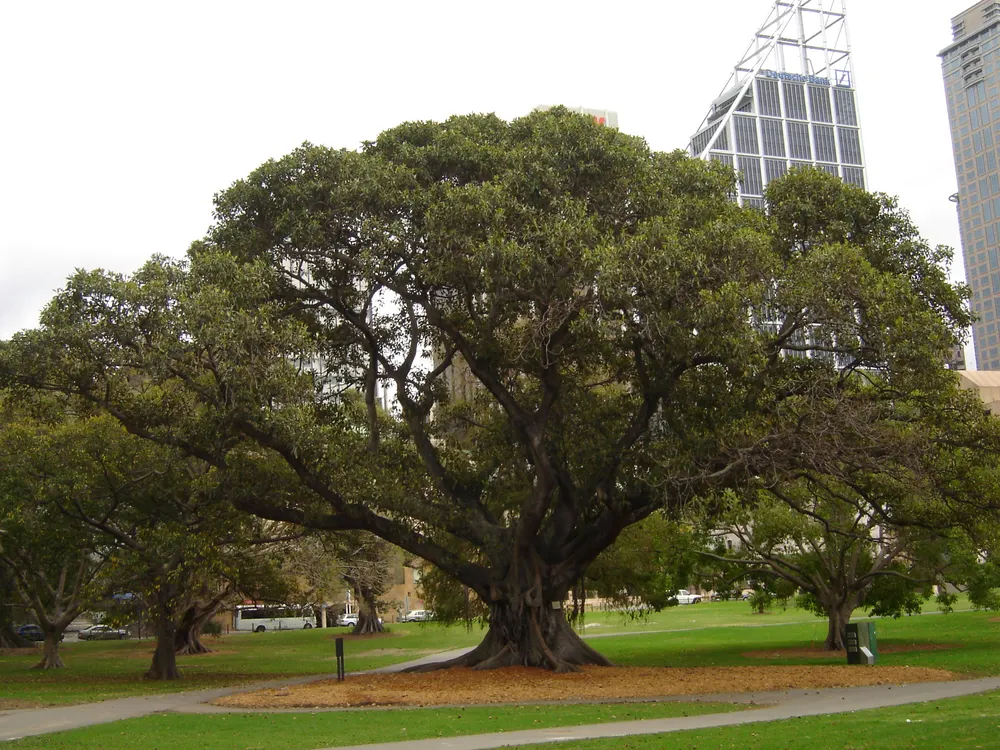
Photo: User DO'Neil on en.wikipedia, CC BY-SA 3.0 (via Wikimedia Commons)
Moreton Bay Fig
Ficus macrophylla
Also known as Australian Banyan, Black Fig, Moreton Bay Banyan
Key benefits
✦Traditional uses
✦This is a tree remembered more for shelter and craft than for the medicine chest. Aboriginal peoples of eastern Australia's coast stripped the fibrous inner bark and pliable aerial roots of the Moreton Bay fig to twist into strong cordage, used for dilly bags, fishing lines, and nets, a practice recorded among several coastal groups who prized the tree's tough, workable fiber. The dense wood and wide, easily worked trunk also lent themselves to canoe and shield making in some regions. Beyond craft, the tree's real gift has always been its shade and shelter, with old specimens becoming natural meeting places, and its fruit sustaining flying foxes, pigeons, and countless other birds that in turn seed the next generation of forest giants.
How to grow & use it
✦The full apothecary for Moreton Bay Fig
Traditional remedies and step-by-step preparations, a complete growing guide, and how to harvest, dry, and store it, all unlocked with HerbLens Unlimited.
- ✦Remedies & preparations
- ✦ Growing guide
- ✦Harvest & storage
From under $6 a month. Free plant identifications always included.
- ✦Ficus religiosa (Bodhi tree)
- ✦Ficus benghalensis (Banyan)
- ✦Ficus benjamina (weeping fig, for smaller landscapes)
“For the tree that will outlive you, and shelter generations you will never meet.”
A single Moreton Bay fig planted in Santa Barbara, California in 1876 has grown so immense that its canopy now shades more than a third of an acre, making it one of the largest trees of its kind in the United States, all from a seedling reportedly carried over in a sailor's pocket.
Not eaten; its milky latex sap can irritate skin, so wear gloves when pruning. Its roots are aggressive enough to damage foundations and pavement, so give it plenty of space away from structures.