Photo: Arx Fortis at English Wikipedia, CC BY-SA 3.0 (via Wikimedia Commons)
Mountain Laurel
Kalmia latifolia
Also known as Calico Bush, Spoonwood, Ivybush, Sheep Laurel (regional, though this properly refers to Kalmia angustifolia)
Traditional uses
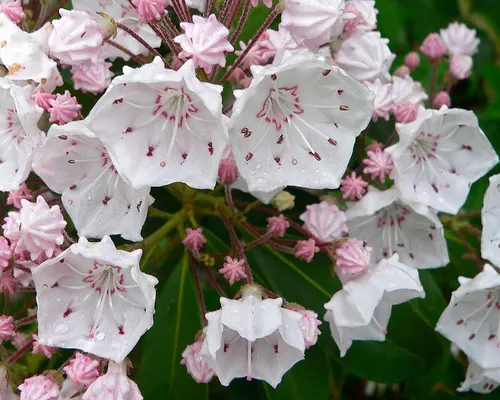
✦Mountain laurel is one of the great spectacles of the Appalachian spring, its branches crowded with clusters of cup shaped flowers that look almost too perfectly formed to be real. Each blossom holds its ten stamens under tension, cocked back into little pockets in the petals like tiny loaded springs, so that a landing bee trips them and gets dusted with a puff of pollen. Cherokee and other Indigenous peoples of the southern Appalachians knew the plant well and used it with great caution and specific knowledge, mostly externally, while also carving its dense, fine grained wood into spoons, pipe bowls, and tool handles, which is where the old name spoonwood comes from. It has never had a place as a home remedy or kitchen herb, and it is grown and admired today strictly as a garden and woodland ornamental.
How to grow & use it
✦The full apothecary for Mountain Laurel
Traditional remedies and step-by-step preparations, a complete growing guide, and how to harvest, dry, and store it, all unlocked with HerbLens Unlimited.
- ✦Remedies & preparations
- ✦ Growing guide
- ✦Harvest & storage
From under $6 a month. Free plant identifications always included.
- ✦Rhododendron
- ✦Azalea
- ✦Ferns
“For the woodland garden that wants a week of pure spectacle each spring, not the medicine cabinet.”
Mountain laurel's stamens are mechanically cocked like tiny catapults. Each one sits tucked into a pouch in the petal, held under spring tension, and when a bee brushes against it the stamen snaps forward and flings pollen onto the visitor, a trick botanists call explosive pollination.
Mountain laurel is toxic and should never be ingested in any form. Every part of the plant, including leaves, flowers, nectar, and pollen, contains grayanotoxins, which can cause vomiting, drooling, weakness, difficulty breathing, dangerous drops in blood pressure, cardiac arrhythmia, and in serious cases death, in both humans and animals including livestock and pets. Even honey made by bees that have fed heavily on Kalmia nectar, sometimes called mad honey, can cause poisoning if eaten. There is no traditional or modern dose of this plant that is considered safe to consume, and it has no established internal or topical herbal use. Keep it out of reach of grazing animals, small children, and anyone inclined to taste garden plants, and if exposure or poisoning is suspected, contact Poison Control or a veterinarian immediately. This entry is for ornamental and botanical reference only. Always consult a qualified professional, such as a toxicologist, physician, or veterinarian, for any concerns about plant poisoning.