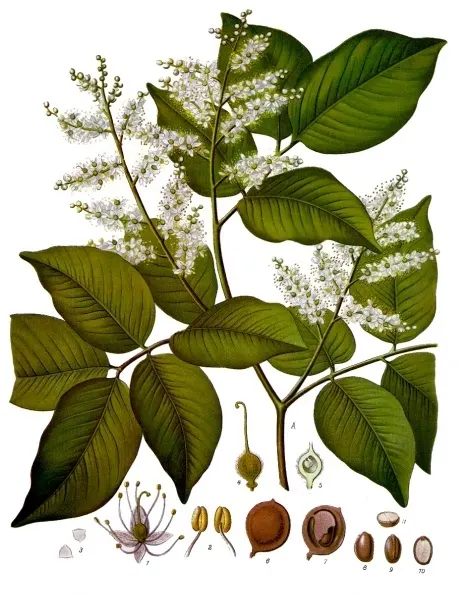
Photo: Franz Eugen Köhler, Köhler's Medizinal-Pflanzen, Public domain (via Wikimedia Commons)
Copaiba
Copaifera officinalis
Also known as Copaiba balsam, Copaiba oil, Copal, Balsam of copaiba, Jesuit's balsam
Key benefits
✦Traditional uses
✦Long before it had a Latin name, copaiba oleoresin was one of the most trusted medicines of Amazonian forest peoples, who tapped it from the trunks of towering Copaifera trees and applied it to wounds, insect bites, and sore skin. Portuguese and Spanish chroniclers took note of it as early as the sixteenth century, and by the colonial era it had become a well-traveled remedy, carried back to Europe as balsam of copaiba and stocked by apothecaries for generations. Traditional healers valued it for calming irritated skin, easing the chest during colds, and dressing minor cuts and burns. It earned a lasting place in old pharmacopoeias as one of the great resins of the New World, alongside frankincense and myrrh from the Old.
How to grow & use it
✦The full apothecary for Copaiba
Traditional remedies and step-by-step preparations, a complete growing guide, and how to harvest, dry, and store it, all unlocked with HerbLens Unlimited.
- ✦Remedies & preparations
- ✦ Growing guide
- ✦Harvest & storage
From under $6 a month. Free plant identifications always included.
- ✦Frankincense
- ✦Myrrh
- ✦Lavender
- ✦Frankincense
- ✦Myrrh
“For the deep, woody balm of the rainforest, when tired skin or a heavy chest calls for something old and trusted.”
A single mature copaiba tree can be tapped for its resin again and again over many decades without lasting harm, much like a sugar maple, sometimes yielding several liters at once from one careful drilling.
Undiluted resin can irritate skin or cause allergic contact dermatitis, so patch test before topical use; internal use isn't recommended, since drinking the resin has caused stomach and kidney irritation. Avoid during pregnancy and breastfeeding and keep away from children.