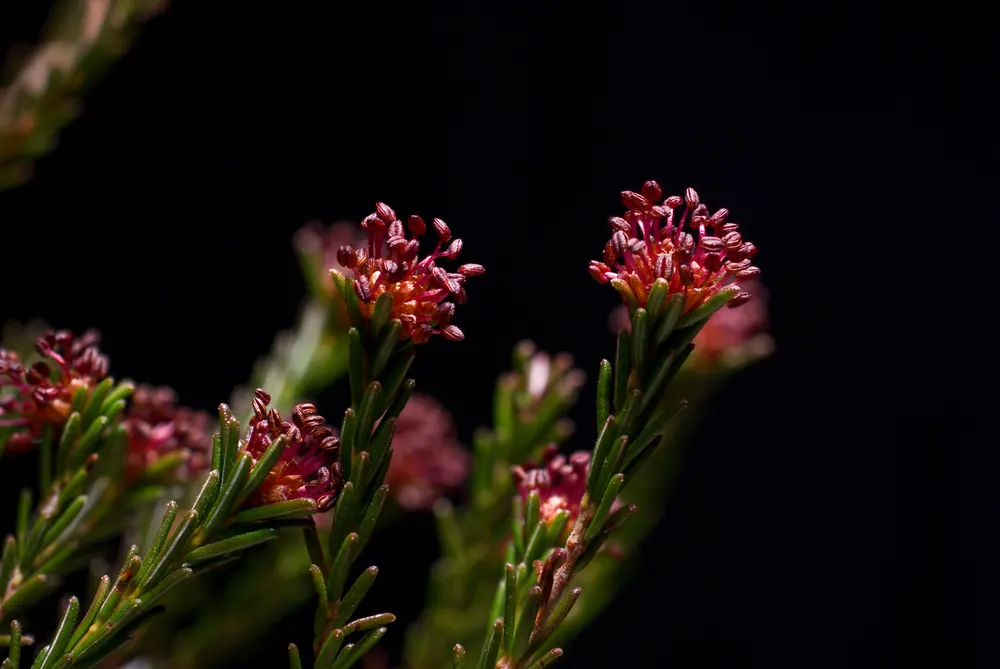
Photo: magnolia1000, CC BY 2.0 (via Wikimedia Commons)
Broom Crowberry
Corema conradii
Also known as Broom Crowberry, Conrad's Broom Crowberry, Poverty Grass
Key benefits
✦Traditional uses
✦Broom crowberry has no meaningful history as a food, medicine, or craft plant. What it has instead is a quiet, specialized role in the ecology of the sandy barrens it calls home, holding thin, wind-scoured soils in place with its tangled roots and offering some of the very first flowers of the year to hungry early pollinators. Coastal communities on Cape Cod, Nantucket, and Martha's Vineyard have long known it simply as part of the heathland scenery, a low gray-green mound that turns a smoky reddish purple when its tiny flowers open before almost anything else has stirred. Its old country name, poverty grass, was not an insult but an observation, a nod to how gracefully it makes a living on soil too poor and dry for most other plants.
How to grow & use it
✦The full apothecary for Broom Crowberry
Traditional remedies and step-by-step preparations, a complete growing guide, and how to harvest, dry, and store it, all unlocked with HerbLens Unlimited.
- ✦Remedies & preparations
- ✦ Growing guide
- ✦Harvest & storage
From under $6 a month. Free plant identifications always included.
- ✦Bearberry (Arctostaphylos uva-ursi)
- ✦Beach heather (Hudsonia tomentosa)
- ✦Lowbush blueberry (Vaccinium angustifolium)
- ✦Beach heather (Hudsonia tomentosa)
- ✦Black crowberry (Empetrum nigrum)
“For the wild garden built on sand and salt air, and for anyone who has ever spotted the first hint of color on a windswept barren while the rest of the landscape still looks like winter.”
Broom crowberry is dioecious, meaning each plant is either male or female, and it blooms so early that its small, petal-less flowers are pollinated entirely by wind, well before bees and other insects have woken up for the season.
Broom crowberry has no established history as a food or medicinal herb, and there is no reliable safety data on ingesting any part of the plant, so it should not be eaten or prepared as a remedy. In several northeastern states it is classified as rare, threatened, or a species of conservation concern, so wild plants and the fragile barren habitats they grow in should never be dug up, cut, or disturbed; admire it in place, or seek out nursery-propagated stock for a garden. As with any plant lacking a documented tradition of internal use, this one is best appreciated for its ecological and landscape value rather than tried as a home remedy. Anyone interested in using native plants medicinally should work from species with a well-documented safety record and speak with a qualified herbalist or healthcare provider before using any new herb, especially during pregnancy, while nursing, or alongside medications.