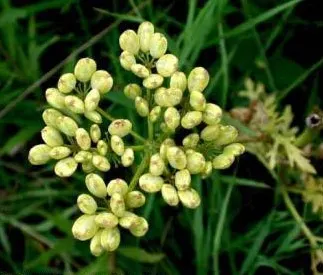
Photo: Dan Busemeyer, Public domain (via Wikimedia Commons)
Prairie Parsley
Polytaenia nuttallii
Also known as Nuttall's Prairie Parsley, Wild Parsley, Prairie Parsnip
Key benefits
✦Traditional uses
✦Prairie parsley does not carry a documented history of folk medicine or kitchen use the way its cousins dill and caraway do. What it carries instead is a quieter kind of value: botanists and prairie restorationists have long treated its presence as a small badge of honor, a sign that a patch of grassland has never been plowed. Nineteenth century plant collectors, working the same tallgrass expanses that gave the species its common name, noted it chiefly for its early, cheerful yellow-green umbels breaking the brown of a prairie just waking from winter. Its greatest traditional role has been ecological rather than medicinal, feeding the first bees of spring and hosting the black swallowtail caterpillar just as other members of the carrot family do.
How to grow & use it
✦The full apothecary for Prairie Parsley
Traditional remedies and step-by-step preparations, a complete growing guide, and how to harvest, dry, and store it, all unlocked with HerbLens Unlimited.
- ✦Remedies & preparations
- ✦ Growing guide
- ✦Harvest & storage
From under $6 a month. Free plant identifications always included.
- ✦Purple Coneflower (Echinacea purpurea)
- ✦Blazing Star (Liatris spicata)
- ✦Black-eyed Susan (Rudbeckia hirta)
- ✦Golden Alexanders (Zizia aurea)
“For the gardener who wants to hear the prairie's first spring hum of bees before anything else has thought to bloom.”
The species name honors Thomas Nuttall, the English botanist who tramped across the American frontier in the early 1800s cataloguing plants no European scientist had yet described, and prairie parsley was one of the many he brought to formal notice.
Prairie parsley belongs to the carrot family, which includes deadly look-alikes such as poison hemlock and water hemlock, so it should never be foraged for eating without expert identification.