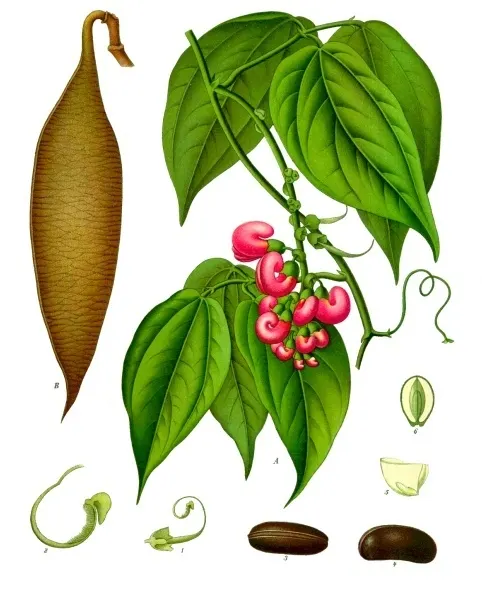
Photo: Franz Eugen Köhler, Köhler's Medizinal-Pflanzen, Public domain (via Wikimedia Commons)
Calabar Bean
Physostigma venenosum
Also known as Ordeal Bean, Chop Nut, Esere Bean, Physostigma
Key benefits
✦Traditional uses
✦The Calabar bean carries one of the most sobering histories of any plant in this atlas. Among the Efik people of old Calabar, in what is now southeastern Nigeria, the crushed seed was used in trial by ordeal, a grim form of justice in which a person accused of witchcraft or a serious crime was made to swallow a dose. Survival was taken as proof of innocence, death as confirmation of guilt, a practice that Western travelers and missionaries recorded with horror through the nineteenth century. It was never a plant of the kitchen or the healer's tea shelf. Its real gift to the world came later, in the laboratory rather than the herb garden, when chemists isolated its active compound and unlocked one of the most important tools in modern pharmacology.
How to grow & use it
✦The full apothecary for Calabar Bean
Traditional remedies and step-by-step preparations, a complete growing guide, and how to harvest, dry, and store it, all unlocked with HerbLens Unlimited.
- ✦Remedies & preparations
- ✦ Growing guide
- ✦Harvest & storage
From under $6 a month. Free plant identifications always included.
“A shadowed vine of the Calabar riverbanks, remembered in this atlas as a warning etched into history rather than a remedy for the shelf.”
When the Scottish physician Thomas Fraser and others studied the Calabar bean in the 1860s and 1870s, they isolated its compound physostigmine and found it constricted the pupil of the eye. That single discovery gave ophthalmologists one of their first reliable treatments for glaucoma, and physostigmine went on to become the chemical blueprint for neostigmine and pyridostigmine, drugs still used today for myasthenia gravis and as antidotes to certain poisons.
Physostigma venenosum is genuinely dangerous and must never be ingested, brewed, or self-prepared in any form. Its seeds contain physostigmine, a powerful acetylcholinesterase inhibitor that overwhelms the nervous system: even small amounts can cause profuse salivation and sweating, vomiting, cramping, tremors, seizures, a dangerously slowed heartbeat, respiratory failure, and death. It was historically used in West Africa as a judicial poison in trials by ordeal and, in other contexts, as an arrow and hunting poison, underscoring just how potent it is. There is no traditional or folk dose considered safe, no home preparation, and no reason for anyone outside of licensed pharmaceutical or research settings to handle the seeds at all. Physostigmine derived from this plant is used in modern medicine only in carefully controlled, professionally administered pharmaceutical forms. Keep the whole plant and its seeds well away from children, pets, and livestock, and if exposure or ingestion is ever suspected, treat it as a medical emergency and contact poison control or a qualified medical professional immediately rather than attempting any home treatment.