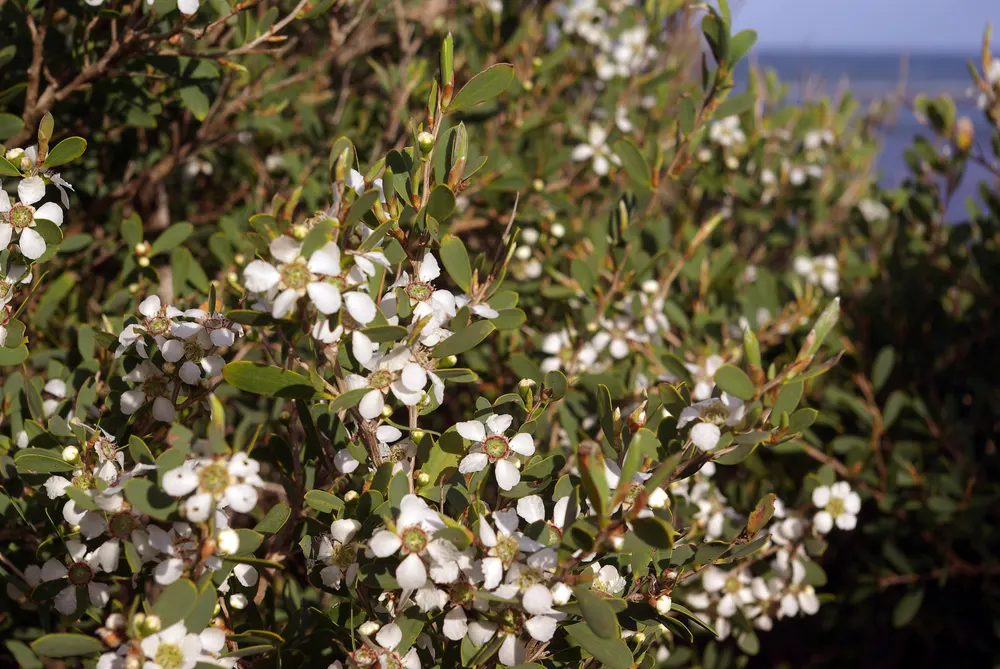
Photo: Stephen Bain, CC BY-SA 3.0 (via Wikimedia Commons)
Coast Tea Tree
Leptospermum laevigatum
Also known as Coastal Teatree, Australian Myrtle, Victorian Tea-tree
Key benefits
✦Traditional uses
✦Long before it ever reached a nursery catalog, coast tea tree was doing quiet, unglamorous work: knitting its roots through loose dune sand along the southeastern Australian coast and holding the land together against wind and tide. Colonial settlers valued its dense, gnarled wood for tool handles and small implements, and later generations planted it by the thousands to reclaim blown-out sand country and stabilize mined or eroded ground. It shares its common name and its genus with the famous manuka of New Zealand, Leptospermum scoparium, but coast tea tree has always been prized for its toughness and its flowers rather than for any kettle or medicine cabinet. Today it is grown chiefly as a windbreak, screen, and habitat plant for gardens that face the sea.
How to grow & use it
✦The full apothecary for Coast Tea Tree
Traditional remedies and step-by-step preparations, a complete growing guide, and how to harvest, dry, and store it, all unlocked with HerbLens Unlimited.
- ✦Remedies & preparations
- ✦ Growing guide
- ✦Harvest & storage
From under $6 a month. Free plant identifications always included.
- ✦Coastal rosemary (Westringia)
- ✦Correa
- ✦Saltbush (Atriplex)
- ✦Leptospermum scoparium (manuka) for similar form with edible honey value
- ✦Melaleuca species for comparable coastal hedging
“For the garden that meets the salt wind head on and still wants to bloom.”
Its cousin Leptospermum scoparium gives us prized manuka honey, but coast tea tree does not, a mix-up that trips up plenty of gardeners who assume every tea tree fills the same role.
Coast tea tree is not eaten or used as a tea or medicine, and its pollen can aggravate hay fever or allergies during its heavy spring bloom.