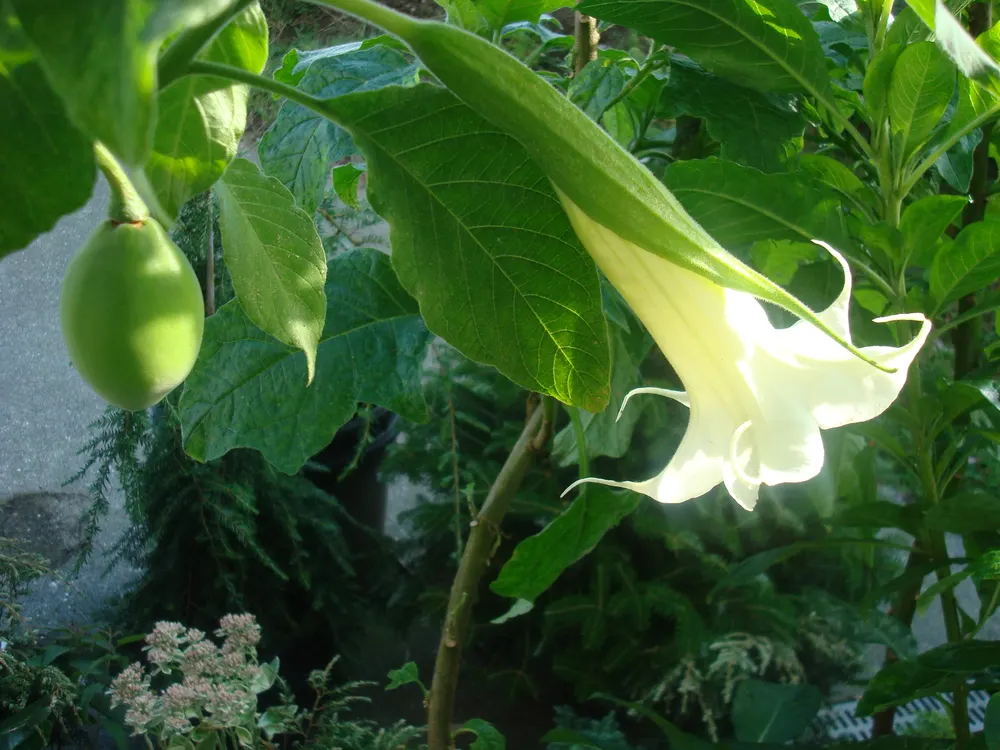
Photo: Tom Hulse, CC BY-SA 3.0 (via Wikimedia Commons)
Angel's Trumpet
Brugmansia arborea
Also known as Angel's Trumpet, Tree Datura, Floripondio, White Angel's Trumpet
Key benefits
✦Traditional uses
✦In its Andean homeland, Brugmansia arborea held a serious and dangerous place in indigenous ceremonial life, where healers and elders sometimes used it under tightly controlled ritual conditions believed to induce trance or communion with ancestors. Colonial chroniclers also recorded darker uses, noting that the plant's disorienting effects made it a tool for coercion rather than healing in some accounts. None of these historical practices are safe to replicate, and the plant survives today almost entirely as a garden ornamental, grown for its extraordinary flowers rather than any use on the body. Remarkably, botanists believe true wild populations of Brugmansia arborea no longer exist, the species having been shaped and spread by human cultivation for so long that it now depends on gardeners to carry it forward.
How to grow & use it
✦The full apothecary for Angel's Trumpet
Traditional remedies and step-by-step preparations, a complete growing guide, and how to harvest, dry, and store it, all unlocked with HerbLens Unlimited.
- ✦Remedies & preparations
- ✦ Growing guide
- ✦Harvest & storage
From under $6 a month. Free plant identifications always included.
“For the gardener who wants a living chandelier of fragrance at dusk, admired at arm's length and never tasted.”
Every wild population of Brugmansia is thought to be gone. The genus is believed to survive today only in cultivation, having been bred and carried from garden to garden by Andean peoples for so many centuries that botanists classify it as extinct in the wild.
Brugmansia arborea is seriously toxic in every part, including its leaves, flowers, seeds, and sap. It contains high concentrations of tropane alkaloids, chiefly scopolamine, atropine, and hyoscyamine, the same compounds found in its infamous relative Datura. Ingesting any part can cause severe delirium, hallucinations, dangerously dilated pupils, racing heart, seizures, coma, and death, and cases of accidental and intentional poisoning, including fatalities, are well documented in medical literature. Even skin contact or handling the flowers can cause irritation or absorb small amounts of alkaloid, so gloves are recommended when pruning. It is unsafe in pregnancy, for children, for pets and livestock, and can dangerously interact with other medications affecting the heart or nervous system. This plant has no traditional or modern role as a home remedy and should never be brewed, smoked, or ingested in any form. Grow it strictly as an ornamental, keep it away from curious children and animals, and contact Poison Control or emergency services immediately if any part is ingested. Always consult a qualified medical professional for any health concern.