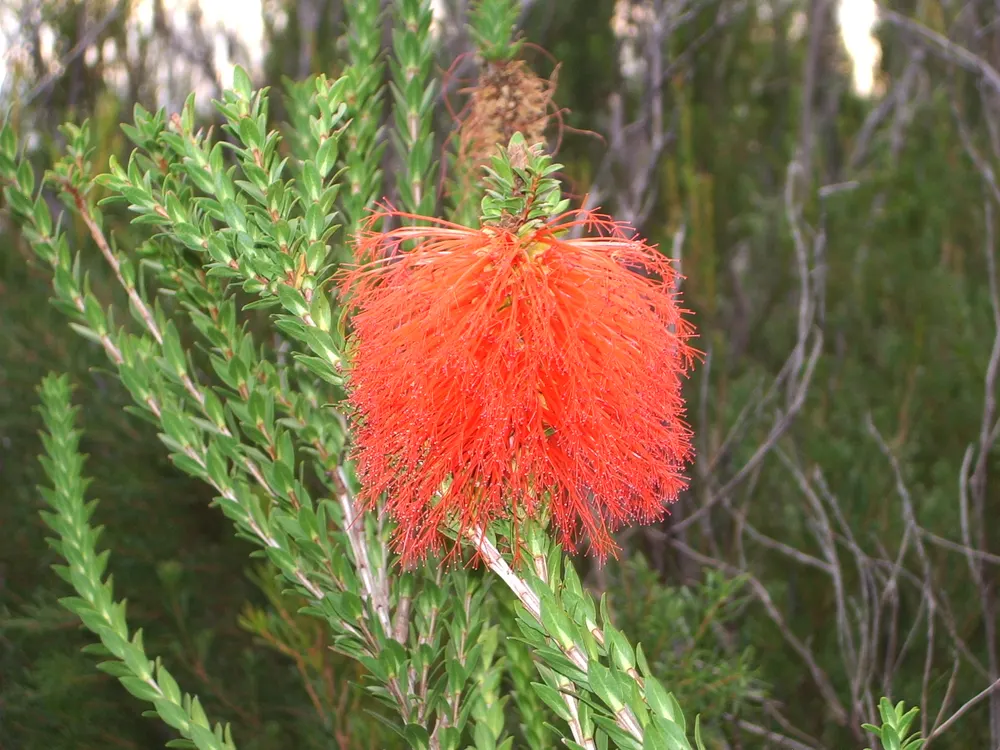
Photo: Hughesdarren, Public domain (via Wikimedia Commons)
Swamp Bottlebrush
Beaufortia sparsa
Also known as Orange Beaufortia
Key benefits
✦Traditional uses
✦Beaufortia sparsa carries no well-documented history as a medicinal or culinary herb, so this entry focuses on what is reliably known about the plant rather than inventing a folk pedigree it does not have. It is a true child of the Kimberley's wet season country, one of a genus of thirty-some Beaufortia species found almost nowhere outside Western Australia, and it has long been noticed and admired for the sheer brightness of its flower spikes rising out of otherwise unassuming swamp scrub. The genus honors Mary Somerset, Duchess of Beaufort, a seventeenth-century English patron of botany, which places this plant in a long lineage of Australian natives named to please faraway gardens rather than to record any local use. Its real legacy has been horticultural: since the twentieth century it has been prized by native-plant growers for the way its orange brushes light up a damp corner where few other shrubs will even take root.
How to grow & use it
✦The full apothecary for Swamp Bottlebrush
Traditional remedies and step-by-step preparations, a complete growing guide, and how to harvest, dry, and store it, all unlocked with HerbLens Unlimited.
- ✦Remedies & preparations
- ✦ Growing guide
- ✦Harvest & storage
From under $6 a month. Free plant identifications always included.
- ✦Callistemon (bottlebrush)
- ✦Kangaroo paw
- ✦Melaleuca
- ✦Callistemon citrinus
- ✦Other Beaufortia species
“For the boggy, sun-baked corner of the garden where nothing else will bloom, and you want it to blaze orange anyway.”
The genus Beaufortia was first described by the botanist Robert Brown in 1812 and named in honor of Mary Somerset, Duchess of Beaufort, an avid English plant collector who never once saw the wild Kimberley swamps her namesake shrub calls home.
This is an ornamental garden and cut flower plant with no established history of internal or medicinal use, so it is not eaten or brewed.