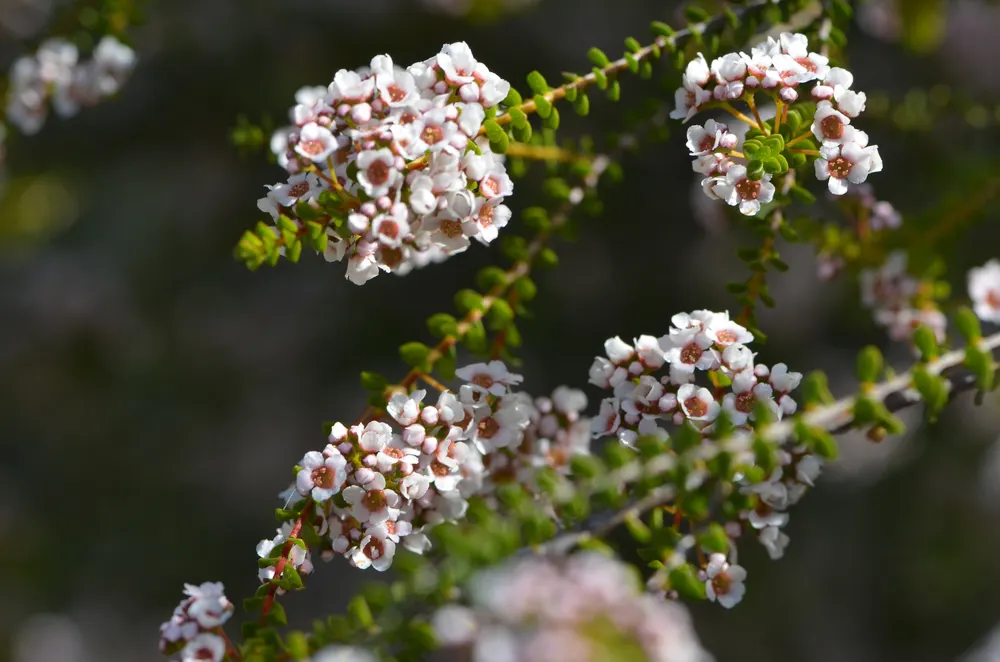
Photo: MargaretRDonald, CC BY-SA 4.0 (via Wikimedia Commons)
Fringe Myrtle
Scholtzia involucrata
Also known as Involucred Scholtzia
Key benefits
✦Traditional uses
✦Scholtzia involucrata belongs to a small genus of shrubs found only in the far southwest corner of Western Australia, one of the most botanically rich and least appreciated corners of the plant world. There is no documented history of it being used as a food, tea, or medicine by any culture, and it seems to have lived quietly in its sand-plain heathlands, doing its work for local pollinators, long before botanists ever gave it a Latin name. Its real story is one of place rather than remedy, a small, wiry survivor of ancient, nutrient-poor soils that host an extraordinary diversity of unique flowering plants found nowhere else on earth. Today it is grown chiefly by native-plant enthusiasts who value it for its airy, fringed flower heads and its unfussy, water-wise nature.
How to grow & use it
✦The full apothecary for Fringe Myrtle
Traditional remedies and step-by-step preparations, a complete growing guide, and how to harvest, dry, and store it, all unlocked with HerbLens Unlimited.
- ✦Remedies & preparations
- ✦ Growing guide
- ✦Harvest & storage
From under $6 a month. Free plant identifications always included.
“For the corner of a native garden that wants texture, pollinators, and not one extra drop of water.”
The species name involucrata comes from the Latin for wrapped in a husk, a nod to the ring of papery bracts that cups each dense little flower head, a feature that helps tell this species apart from its many Scholtzia cousins.
Fringe myrtle has no history of use as a food or medicine and should not be ingested. Pruning may irritate sensitive skin, and it should be kept away from pets or children who might chew the foliage.