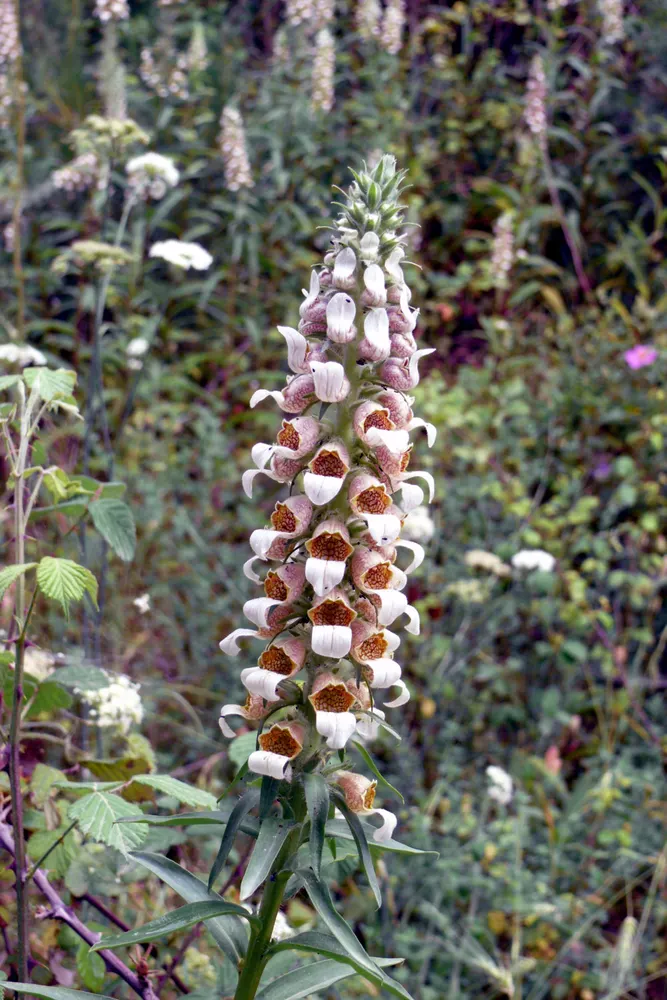
Photo: User:Haplochromis, CC BY 2.5 (via Wikimedia Commons)
Woolly Foxglove
Digitalis lanata
Also known as Grecian Foxglove, Digitalis, Lanata Foxglove
Key benefits
✦Traditional uses
✦Long before it entered the pharmacy, the foxglove family held a shadowed place in European folk medicine, whispered about as both a healer and a poison depending on the hand that prepared it. In 1785, the English physician William Withering published his famous account of foxglove after learning of a family recipe used by a Shropshire herbalist to treat dropsy, what we now recognize as the fluid swelling of heart failure. Digitalis lanata in particular became prized by nineteenth and twentieth century chemists because its leaves yield a more consistent, measurable glycoside content than its cousin Digitalis purpurea, and it remains the primary botanical source from which the modern prescription drug digoxin is derived today. Its story is really the story of how a dangerous wild plant became, through careful science, one of the most important medicines in cardiology.
How to grow & use it
✦The full apothecary for Woolly Foxglove
Traditional remedies and step-by-step preparations, a complete growing guide, and how to harvest, dry, and store it, all unlocked with HerbLens Unlimited.
- ✦Remedies & preparations
- ✦ Growing guide
- ✦Harvest & storage
From under $6 a month. Free plant identifications always included.
The lanatoside C compound isolated from Digitalis lanata gave rise to digoxin, a drug still prescribed today for heart failure and irregular heart rhythms, meaning a plant once gathered in folk remedies for dropsy now reaches patients through a carefully measured pharmacy tablet instead of a garden cup.
Digitalis lanata is highly toxic in every part, including its leaves, flowers, seeds, and roots. It contains potent cardiac glycosides, including lanatoside C, the precursor to the prescription drug digoxin, which can cause dangerous and potentially fatal heart arrhythmias even in small amounts. Symptoms of poisoning include nausea, vomiting, visual disturbances such as seeing halos or yellow-green tinted vision, confusion, and irregular or slowed heartbeat. It has an extremely narrow margin between an inert amount and a toxic one, and it is easily mistaken by foragers for edible leaves such as comfrey or borage, a confusion that has caused real poisonings. It is dangerous for pregnant or nursing individuals, for anyone on heart medication, diuretics, or blood pressure drugs, and for children and pets, who should never have access to the plant. This entry is provided for historical and botanical interest only. Digitalis lanata should never be steeped, tinctured, or ingested in any home preparation. If exposure or ingestion is suspected, contact emergency services or a poison control center immediately, and always consult a qualified medical professional before using any plant-derived heart remedy.