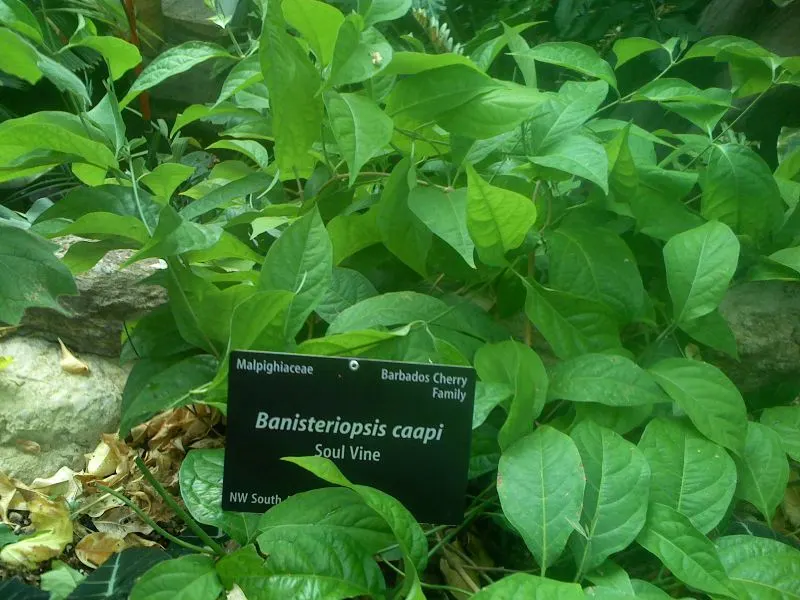
Photo: Original uploader was Wowbobwow12 at en.wikipedia, CC BY-SA 3.0 (via Wikimedia Commons)
Ayahuasca Vine
Banisteriopsis caapi
Also known as Caapi, Yagé, Yajé, Pinde, Natem
Key benefits
✦Traditional uses
✦For countless generations, Amazonian peoples including the Shipibo, Quechua, Tukano, and Shuar have pounded and boiled the bark of this heavy jungle liana as the foundational ingredient of ayahuasca, a ceremonial brew used under the guidance of trained curanderos and shamans for healing rituals, divination, and spiritual work. The vine itself is often called the teacher, believed by many Indigenous communities to carry its own consciousness and guidance. Its alkaloids, the harmala compounds harmine, harmaline, and tetrahydroharmine, were first isolated by Western chemists in the nineteenth and twentieth centuries and remain of great interest to pharmacology today. Because the plant is almost always prepared in combination with other botanicals in a precise, practitioner-led ritual, it has never been a casual home remedy in its places of origin.
How to grow & use it
✦The full apothecary for Ayahuasca Vine
Traditional remedies and step-by-step preparations, a complete growing guide, and how to harvest, dry, and store it, all unlocked with HerbLens Unlimited.
- ✦Remedies & preparations
- ✦ Growing guide
- ✦Harvest & storage
From under $6 a month. Free plant identifications always included.
- ✦Chacruna (Psychotria viridis)
- ✦Chaliponga (Diplopterys cabrerana)
“Known across the Amazon as the vine of souls, it belongs to ceremony, lineage, and trained hands, not to a home apothecary shelf.”
The vine's alkaloid harmine takes its name from the Arabic and Persian word for the unrelated plant Peganum harmala (Syrian rue), because both plants were later found to contain nearly identical MAO-inhibiting compounds, a discovery that helped connect Amazonian and Old World ethnobotany.
Banisteriopsis caapi is a powerful psychoactive plant and is not safe for casual, self-directed, or home use. Its bark contains potent harmala alkaloids that act as monoamine oxidase inhibitors (MAOIs), and it is the base ingredient of the ayahuasca brew, which is strongly hallucinogenic when combined with DMT-containing plants. MAOIs carry serious risks of dangerous, potentially fatal interactions with many prescription medications (including SSRIs, SNRIs, MAOIs, and certain pain, cold, and psychiatric medications), with recreational drugs, and with tyramine-rich foods, and can trigger serotonin syndrome or hypertensive crisis. It is not appropriate for anyone who is pregnant or breastfeeding, and it can be dangerous for people with cardiovascular, psychiatric, or certain other medical conditions. Its legal status varies widely by country, and brews containing DMT are controlled substances in many jurisdictions, including the United States. This plant should never be sought out, prepared, or ingested outside of a legal, experienced, and medically screened ceremonial context, and anyone considering it should first speak with a qualified healthcare professional and understand the laws where they live.