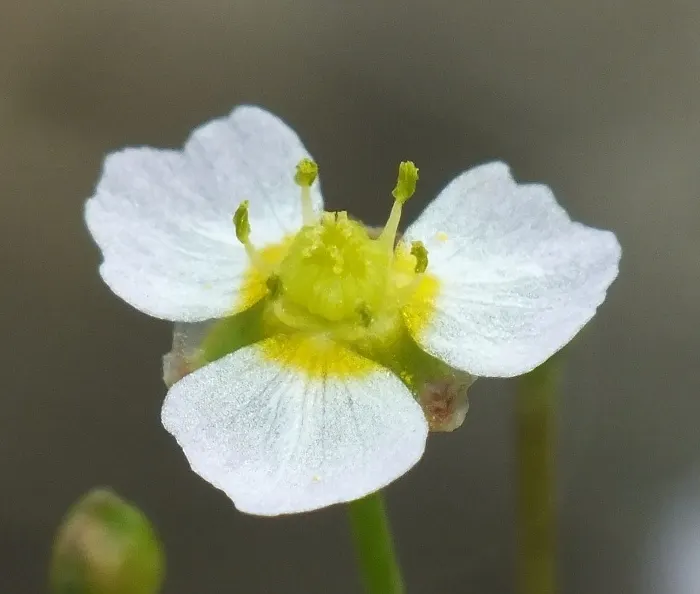
Photo: Иван Пристрем, CC0 (via Wikimedia Commons)
Narrow-leaved Water-Plantain
Alisma gramineum
Also known as Grass-leaved Water-Plantain, Narrow-leaf Water-Plantain, Ribbon-leaved Water-Plantain
Key benefits
✦Traditional uses
✦Alisma gramineum is the slighter, narrower-leaved cousin within a family best known through Alisma plantago-aquatica, whose rhizome has long been used in traditional Chinese medicine, known as Ze Xie, and valued as a diuretic for edema and urinary discomfort. Alisma gramineum itself has never carried that same documented history of use, and no reliable traditional remedy tradition has been recorded for this particular species. Instead, it has lived quietly at the water's edge, appreciated by wetland gardeners and botanists for its wispy, grass-like foliage and its steady presence along pond margins. Its story is one of a plant valued for what it is, a graceful piece of the wetland community, rather than for what it treats.
How to grow & use it
✦The full apothecary for Narrow-leaved Water-Plantain
Traditional remedies and step-by-step preparations, a complete growing guide, and how to harvest, dry, and store it, all unlocked with HerbLens Unlimited.
- ✦Remedies & preparations
- ✦ Growing guide
- ✦Harvest & storage
From under $6 a month. Free plant identifications always included.
- ✦Sweet flag (Acorus calamus)
- ✦Pickerelweed (Pontederia cordata)
- ✦Blue flag iris (Iris versicolor)
- ✦Common water-plantain (Alisma plantago-aquatica), the related species with a documented traditional herbal history
“For the quiet grace of a pond's shallow margin, not for the apothecary shelf.”
Alisma gramineum shows two different leaf forms on the same plant depending on the water: when fully submerged, its leaves grow as thin, ribbon-like blades that sway in the current, but where they reach the surface or open air, the leaves broaden into a more typical lance shape.
Alisma gramineum has no established history of internal or medicinal use and has not been evaluated for edibility or safety in humans, so it should not be eaten or brewed. It is easy to confuse in the field with its better-known relative, Alisma plantago-aquatica, which does carry a documented traditional history, so misidentification is a real risk for anyone tempted to forage it. Like many wetland plants, it can also take up contaminants from the water and mud it grows in, which is another reason to leave it as a pond and garden plant rather than a kitchen or apothecary one. If you are curious about water-plantain as an herbal remedy, speak with a qualified herbalist or healthcare provider first, and be especially cautious during pregnancy or nursing, when unverified plants are best avoided altogether.