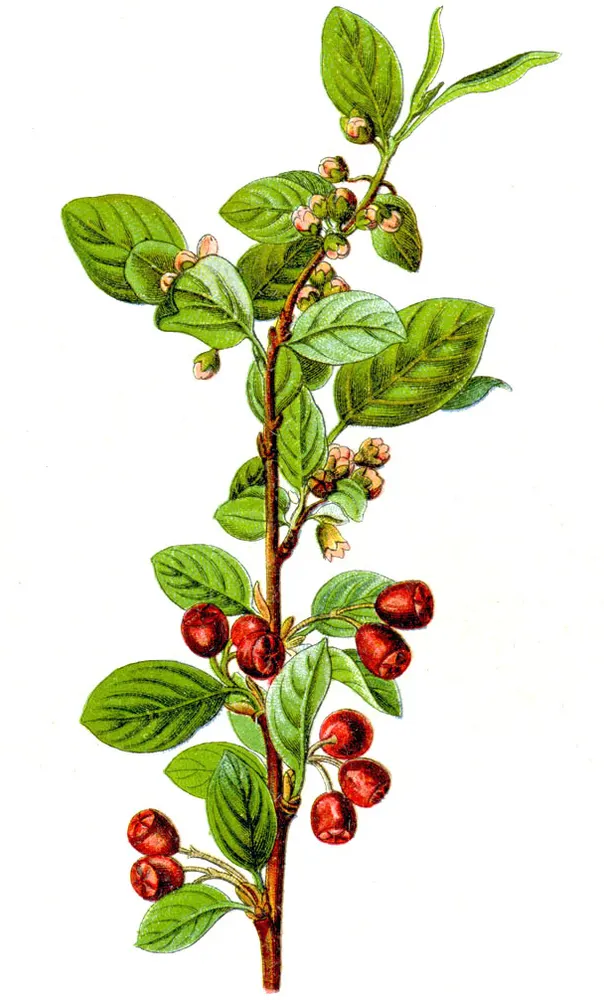
Photo: Johann Georg Sturm (Painter: Jacob Sturm), Public domain (via Wikimedia Commons)
Common Cotoneaster
Cotoneaster integerrimus
Also known as European Cotoneaster, Entire-leaved Cotoneaster, Rock Cotoneaster
Key benefits
✦Traditional uses
✦Cotoneaster integerrimus has never held a real place in the herbalist's cabinet, and that absence is worth stating plainly rather than dressing up. Its true legacy is as a hardscrabble mountain shrub, planted along banks and stone walls across Europe to hold soil in place and to give shelter and berries to birds through the leanest months. Old hedgerow traditions favored it for exactly the qualities that make it a poor medicine plant and a fine garden one: unfussy roots, a wiry structure that shrugs off wind and drought, and fruit that ripens bright red just as the rest of the garden is going quiet. Think of it as a plant valued for what it does in the landscape, not for what it treats in the body.
How to grow & use it
✦The full apothecary for Common Cotoneaster
Traditional remedies and step-by-step preparations, a complete growing guide, and how to harvest, dry, and store it, all unlocked with HerbLens Unlimited.
- ✦Remedies & preparations
- ✦ Growing guide
- ✦Harvest & storage
From under $6 a month. Free plant identifications always included.
- ✦Hawthorn (Crataegus)
- ✦Rowan (Sorbus aucuparia)
- ✦Blackthorn (Prunus spinosa)
- ✦Firethorn (Pyracantha)
- ✦Hawthorn (Crataegus)
“For the bare, sunbaked bank where nothing else wants to grow, and the birds who need somewhere to feast when winter closes in.”
The genus name Cotoneaster comes from the Latin cotoneum, meaning quince, plus the suffix -aster, meaning a resembler or imitator, since early botanists thought its leaves looked like a small quince. Cotoneaster integerrimus is the very species that gave the whole genus its name, making it the original cotoneaster of Europe's rocky slopes.
Cotoneaster berries contain cyanogenic glycosides, the same class of compound found in apple seeds and cherry pits, and eating them can cause nausea, vomiting, and stomach upset in people and pets. No part of this plant should be eaten; if a child, adult, or pet eats the berries, contact poison control or a veterinarian promptly.