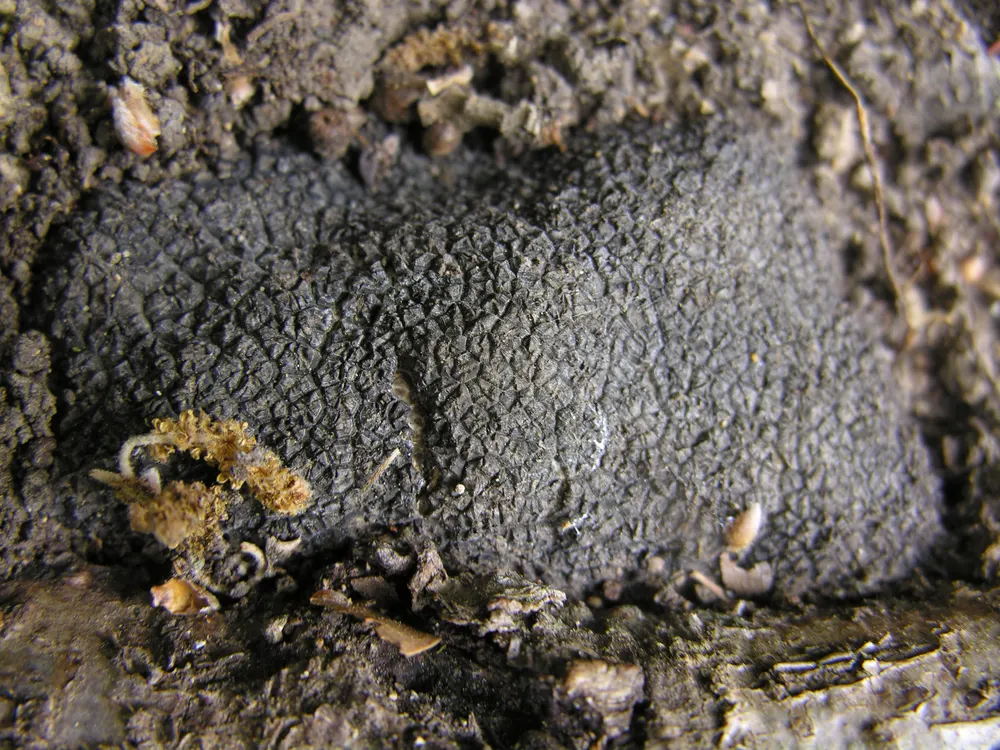
Photo: This illustration was made by (User:Royonx) and released under the license(s) stated above. You are free to use it for any purpose as long as you credit me and follow the terms of the license. Example : © Michel Royon / Wikimedia Commons If you use this image outside of the Wikimedia projects, I would be happy to hear from you par courriel ( royonx gmail.com). Thanks ! Ce message en français, CC BY-SA 3.0 (via Wikimedia Commons)
Black Truffle (Périgord Truffle)
Tuber melanosporum
Also known as Périgord Truffle, French Black Truffle, Winter Black Truffle
Key benefits
✦Traditional uses
✦Long before anyone understood the underground partnership between truffle and oak root, cooks in southern France and Italy simply knew that certain hillsides, and certain seasons, produced something extraordinary buried beneath the leaf litter. The Black Périgord Truffle became the centerpiece of winter tables, shaved sparingly over eggs, tucked into pâtés, and warmed gently in butter to release its earthy, almost musky perfume. It has never been a medicine in any real sense, its value has always been culinary and celebratory, a rare and fleeting luxury tied to the cold months and the patient work of truffle hunters and their dogs. In old Périgord households, a truffle was often kept whole in a jar of raw eggs for a few days before use, so the shells would soak up its fragrance and turn a simple omelet into something memorable.
How to grow & use it
✦The full apothecary for Black Truffle (Périgord Truffle)
Traditional remedies and step-by-step preparations, a complete growing guide, and how to harvest, dry, and store it, all unlocked with HerbLens Unlimited.
- ✦Remedies & preparations
- ✦ Growing guide
- ✦Harvest & storage
From under $6 a month. Free plant identifications always included.
- ✦Fresh thyme
- ✦Bay leaf
- ✦Flat leaf parsley
- ✦Tuber aestivum, the milder summer truffle
- ✦Cremini or porcini mushrooms for an earthy, budget friendly stand in
“For the one meal a year meant to feel like an occasion, when a single shaving can perfume an entire dish.”
For centuries, pigs were the truffle hunter's partner of choice, not because of trainability but because truffles contain a compound closely related to a pheromone found in boar saliva, which draws sows to dig with real enthusiasm. Most hunters now use dogs instead, mainly because a hungry pig has little interest in sharing its find.
Black truffle carries no known toxicity and is safe as a culinary seasoning in normal amounts. Truffle products, especially truffle oil, are frequently adulterated or synthetic, so buy from a reputable, traceable source.