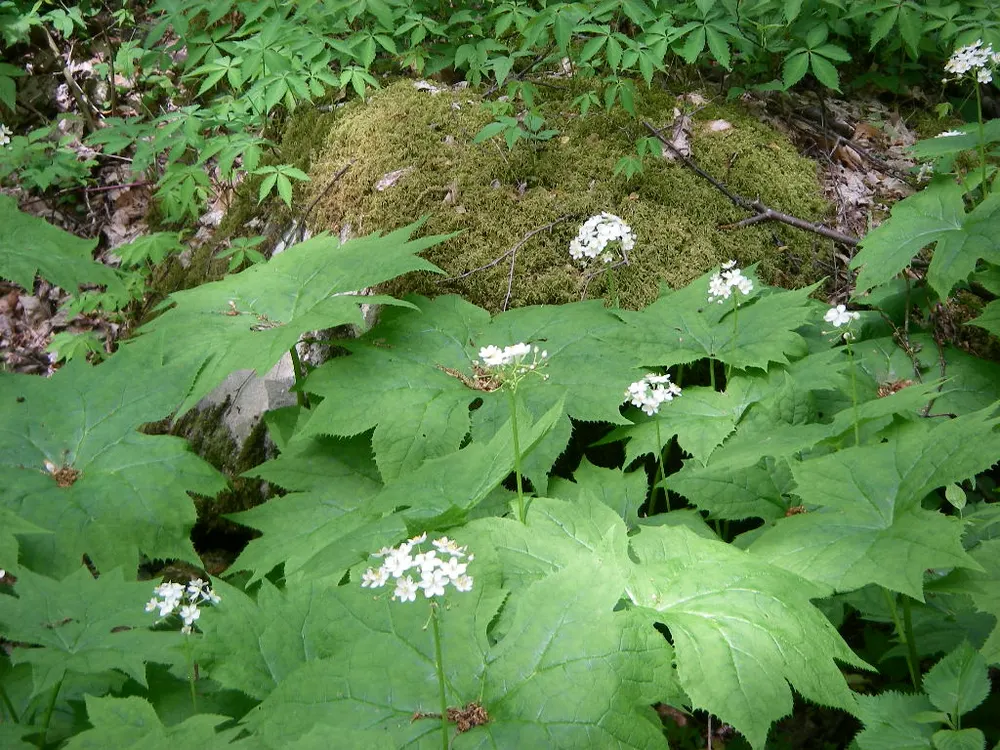
Photo: Halpaugh, CC0 (via Wikimedia Commons)
Umbrella Leaf
Diphylleia cymosa
Also known as Umbrella-leaf, American Umbrella Leaf
Key benefits
✦Traditional uses
✦Umbrella leaf is, first and foremost, a plant of quiet botanical wonder rather than the medicine chest. It has no substantial documented history of use among Appalachian herbalists or Native American traditions in the way that many of its woodland neighbors do, and modern field guides describe it chiefly as a garden and conservation curiosity, prized for its outsized leaves and its role as an indicator of healthy, undisturbed mountain forest. Its closest relative, mayapple, carries a long and storied medicinal history, but that history does not extend to Diphylleia cymosa itself, and its value has always leaned toward the ornamental and the ecological rather than the medicinal.
How to grow & use it
✦The full apothecary for Umbrella Leaf
Traditional remedies and step-by-step preparations, a complete growing guide, and how to harvest, dry, and store it, all unlocked with HerbLens Unlimited.
- ✦Remedies & preparations
- ✦ Growing guide
- ✦Harvest & storage
From under $6 a month. Free plant identifications always included.
- ✦Ferns
- ✦Trillium
- ✦Wild ginger
“When you want to bring a piece of the old, shaded Appalachian cove forest into a damp, quiet corner of the garden.”
The genus name Diphylleia comes from the Greek for two leaves, a nod to how each mature stem forks into a pair of enormous, deeply lobed leaves that look like they belong on something tropical, not something that survives a mountain winter. Once the white flowers fade, the berries that follow ripen to a startling cobalt blue on bright red stalks, a color pairing so vivid that botanists have used the plant as a marker of undisturbed, old-growth cove forest when they find it growing wild.
Umbrella leaf has no established history of medicinal use, and no part of it, including the berries, is considered safe to eat. It's related to mayapple, whose parts are toxic, so keep curious children and pets away from the berries.