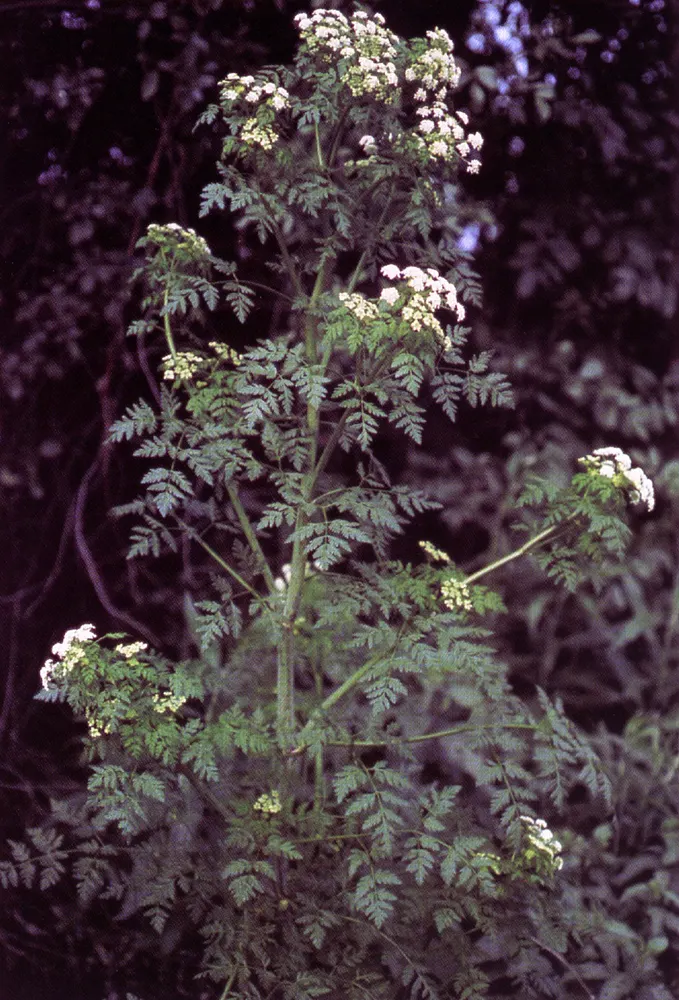
Photo: Public domain (via Wikimedia Commons)
Poison Hemlock
Conium maculatum
Also known as Poison Hemlock, Hemlock, Spotted Hemlock, Poison Parsley, Devil's Bread
Key benefits
✦Traditional uses
✦Poison hemlock holds a somber place in history rather than a healing one. In ancient Greece it was the plant used to carry out state executions, most famously the death of the philosopher Socrates in 399 BCE, who was made to drink a hemlock infusion after his trial in Athens. Early physicians experimented cautiously with it as a sedative and pain reliever in tiny, closely measured doses, but the margin between a dose that did anything at all and one that killed was so slim that its use was abandoned centuries ago as far too dangerous. Today the plant survives mainly as a cautionary chapter in field guides and herbals, a reminder of how easily a lacy white umbel can hide something lethal.
How to grow & use it
✦The full apothecary for Poison Hemlock
Traditional remedies and step-by-step preparations, a complete growing guide, and how to harvest, dry, and store it, all unlocked with HerbLens Unlimited.
- ✦Remedies & preparations
- ✦ Growing guide
- ✦Harvest & storage
From under $6 a month. Free plant identifications always included.
“The plant you learn to recognize, never to gather.”
Poison hemlock is often mistaken for gentler relatives in the carrot family, like wild carrot (Queen Anne's lace), parsley, or fennel, which is exactly why it has caused so many accidental poisonings over the centuries. One reliable clue is the stem: hemlock's is smooth, hollow, and marked with irregular purple or reddish blotches, a feature none of its edible look-alikes share.
Poison hemlock is one of the most toxic plants in North America and Europe, and every part of it, leaves, stems, flowers, seeds, and roots, contains coniine and related piperidine alkaloids that disrupt the nervous system. Ingesting even a small amount can cause trembling, drooling, dilated pupils, weakness, and progressive paralysis that shuts down the muscles used for breathing, and it has caused death in both people and livestock. The sap can also irritate skin and eyes on contact, and burning the plant can release harmful fumes, so it should not be handled bare-handed, mowed carelessly, or burned. It is frequently confused with edible relatives such as wild carrot, wild parsnip, parsley, and fennel, which has led to serious accidental poisonings when people mistake it for a safe wild edible. There is no traditional or modern preparation of this plant that is safe to consume, and it should never be ingested in any form, in any amount, for any reason. If you suspect exposure or ingestion, treat it as a medical emergency and contact poison control or emergency services immediately, and always consult a qualified botanist or professional for positive identification before handling any wild plant in the carrot family.