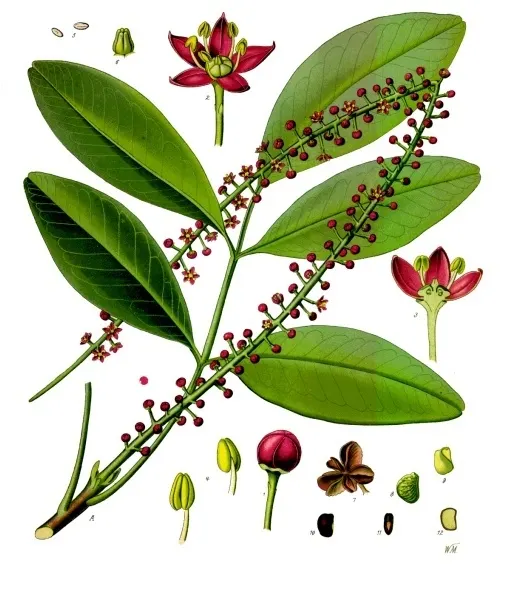
Photo: Franz Eugen Köhler, Köhler's Medizinal-Pflanzen, Public domain (via Wikimedia Commons)
Jaborandi
Pilocarpus jaborandi
Also known as Pernambuco Jaborandi, Arruda Brava, Juarandi
Traditional uses
✦Jaborandi takes its name from a Tupi-Guarani word roughly meaning slobber-mouth plant, a nod to the intense salivation its leaves were known to provoke. For generations, indigenous communities in northeastern Brazil chewed or brewed the leaves as a diaphoretic, a preparation meant to bring on heavy sweating during fevers and as a form of ritual purification. In the late 1800s, Brazilian physicians and then European chemists took notice of this dramatic effect, isolating the alkaloid pilocarpine from the leaves in 1875. That discovery carried jaborandi out of folk practice and into modern pharmacology, where pilocarpine remains in use today for conditions affecting the eyes and salivary glands, always under close medical supervision.
How to grow & use it
✦The full apothecary for Jaborandi
Traditional remedies and step-by-step preparations, a complete growing guide, and how to harvest, dry, and store it, all unlocked with HerbLens Unlimited.
- ✦Remedies & preparations
- ✦ Growing guide
- ✦Harvest & storage
From under $6 a month. Free plant identifications always included.
“A plant for the pharmacology books, not the tea cupboard.”
Pilocarpine, the compound chemists isolated from jaborandi leaves in 1875, is still used in eye drops today to constrict the pupil and lower pressure inside the eye, making this rainforest shrub a direct ancestor of a treatment still found in modern medicine cabinets.
Jaborandi is a genuinely potent plant, not a gentle kitchen herb. Its leaves contain pilocarpine, a strong cholinergic alkaloid that stimulates the nervous system's parasympathetic branch, and even modest amounts can trigger profuse sweating, drooling, watery eyes, nausea, vomiting, cramping, and a dangerously slowed heartbeat. In people with asthma or other reactive airway conditions it can provoke bronchospasm, and its cardiac effects make it risky for anyone with heart disease. It is not appropriate during pregnancy or breastfeeding. Because the margin between a physiological dose and an overdose is narrow, jaborandi is not something to self-prepare as a home tea or tincture. It has a real and respected place in modern medicine, but only in precisely measured, professionally administered forms such as prescription eye drops or salivary stimulant medications. Please do not attempt to harvest, brew, or dose this plant yourself. If you are curious about jaborandi or pilocarpine for a medical condition, that conversation belongs with a licensed physician or pharmacist.