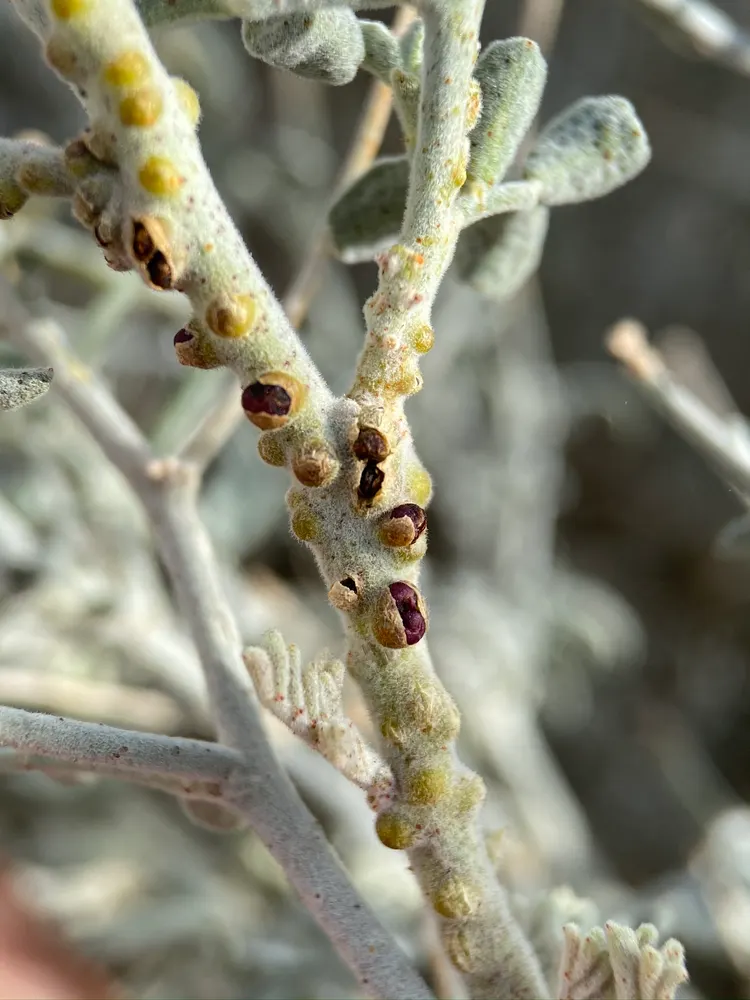
Photo: (c) Matt Berger, some rights reserved (CC BY), CC BY 4.0 (via Wikimedia Commons)
Thurber's Pilostyles
Pilostyles thurberi
Also known as Desert Pilostyles, Pilostyles
Key benefits
✦Traditional uses
✦Pilostyles thurberi has no known history in traditional herbalism, cooking, or folk medicine, and that absence is part of what makes it remarkable. It spends nearly its entire life hidden as thread-like strands woven through the stem tissue of desert shrubs in the pea family, most often Psorothamnus and Dalea species, drawing all its water and nourishment from its host like a plant-eating plant. The only sign it exists at all is a scatter of pinhead-sized flower buds that push up through the host's bark, looking almost like a rash or a cluster of tiny barnacles. Desert botanists and naturalists have long prized the rare sighting of it in bloom as a small, thrilling puzzle of the Sonoran Desert rather than a plant to gather or use.
How to grow & use it
✦The full apothecary for Thurber's Pilostyles
Traditional remedies and step-by-step preparations, a complete growing guide, and how to harvest, dry, and store it, all unlocked with HerbLens Unlimited.
- ✦Remedies & preparations
- ✦ Growing guide
- ✦Harvest & storage
From under $6 a month. Free plant identifications always included.
“For the rare moment when wonder itself is the find, not the herb.”
Pilostyles thurberi ranks among the smallest flowering plants on Earth. Its whole body lives as near-microscopic strands inside the stem of its host shrub, so the plant is essentially invisible for most of the year, only announcing itself when its minute flower buds break through the host's bark like tiny freckles.
Pilostyles thurberi has no history of food or medicinal use and no safety data, so it should not be eaten or used as a remedy. It is also extremely rare and best left undisturbed in the wild.