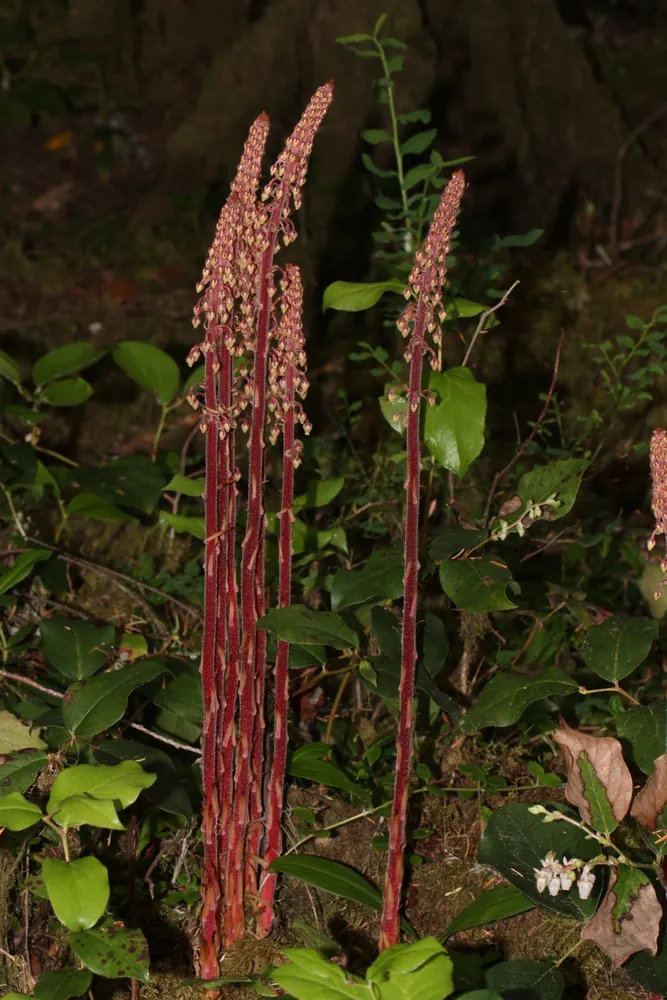
Photo: Walter Siegmund (talk), CC BY-SA 3.0 (via Wikimedia Commons)
Pinedrops
Pterospora andromedea
Also known as Woodland Pinedrops, Giant Pinedrops
Key benefits
✦Traditional uses
✦Long before botanists understood how it survived without a single green leaf, pinedrops caught the attention of the people who shared its forests. Several Native nations of western and northern North America, including Gosiute, Paiute, Shoshoni, and Washoe communities, are recorded as having used infusions or decoctions of the plant for stomach complaints, kidney and bladder troubles, and as a wash or poultice for sores. The Cheyenne are said to have valued the dried, rust-colored stalks for their own reasons beyond the physical, keeping them as a plant of protection. Because it cannot be cultivated and rarely grows thick enough to gather without harm, pinedrops never became a mainstay of any materia medica, but it remained a quietly respected part of forest life and lore.
How to grow & use it
✦The full apothecary for Pinedrops
Traditional remedies and step-by-step preparations, a complete growing guide, and how to harvest, dry, and store it, all unlocked with HerbLens Unlimited.
- ✦Remedies & preparations
- ✦ Growing guide
- ✦Harvest & storage
From under $6 a month. Free plant identifications always included.
“For the forest floor's strangest magic trick, look for the rust red stalk that never bothered to turn green.”
Pinedrops never bothers to turn green. It has no chlorophyll at all, so instead of making its own food from sunlight, it taps directly into the underground fungal threads wrapped around a nearby conifer's roots and quietly draws off sugars the tree made through photosynthesis. Its dried, wiry red stalks are so sturdy that they often stand through an entire winter, long after the flowers and forest around them have gone quiet.
Pinedrops has no reliable record of food or medicinal use, so no safe dose can be given. It's also rare or endangered across much of its range and dies when dug up, so it's best left growing wild rather than harvested.