Photo: Jörg Hempel, CC BY-SA 3.0 de (via Wikimedia Commons)
Dragon Arum
Dracunculus vulgaris
Also known as Voodoo Lily, Stink Lily, Snake Lily, Black Arum
Key benefits
✦Traditional uses
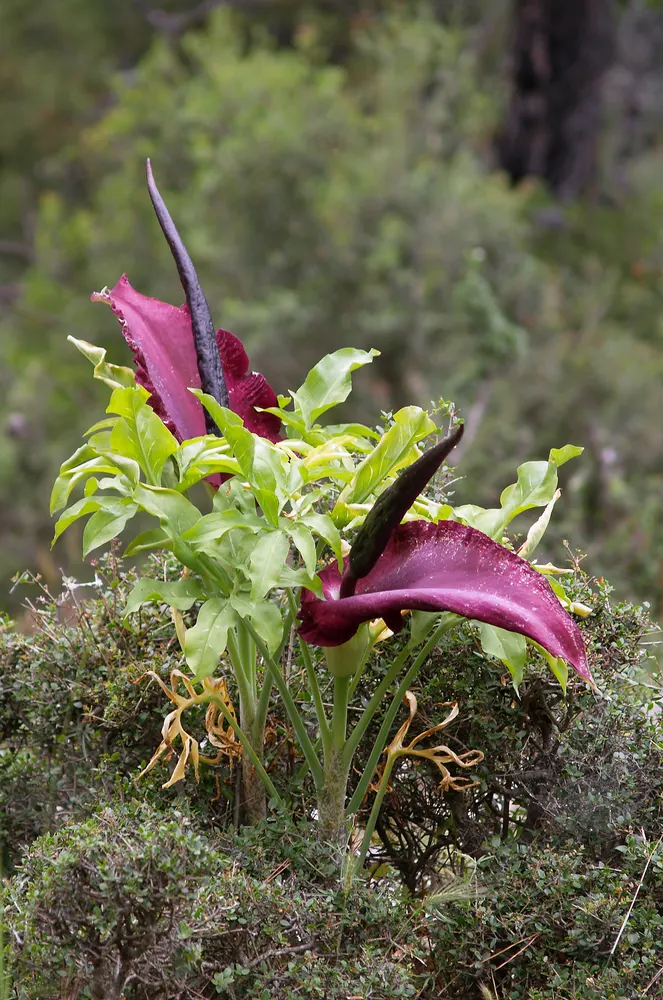
✦Dragon arum has never been an herb of the kitchen or the medicine chest. Its fame is theatrical. For centuries it has grown wild across the rocky slopes of Greece and the Aegean islands, where villagers knew to give it a wide berth and children were warned off its glossy purple-black spike. In some old Cretan households the corm was, in truly hard famine years, boiled and leached at length before anyone would consider touching it, a desperate practice from a hungry past rather than a remedy, and one no modern grower should ever repeat. Its real legacy is as a plant of astonishment, prized in Mediterranean and cottage gardens for the sheer spectacle of its bloom.
How to grow & use it
✦The full apothecary for Dragon Arum
Traditional remedies and step-by-step preparations, a complete growing guide, and how to harvest, dry, and store it, all unlocked with HerbLens Unlimited.
- ✦Remedies & preparations
- ✦ Growing guide
- ✦Harvest & storage
From under $6 a month. Free plant identifications always included.
- ✦Euphorbia characias
- ✦Iris unguicularis
- ✦Cyclamen hederifolium
- ✦Arum italicum
- ✦Amorphophallus konjac
“When your spring garden could use one glorious, slightly sinister surprise.”
The dark spadix at the center of the bloom can warm itself several degrees above the surrounding air through a process called thermogenesis, a trick that helps carry its rotting-meat odor further on the breeze and draws in the carrion flies and beetles that pollinate it.
Every part of Dracunculus vulgaris, especially the corm and the berries that follow the bloom, is loaded with needle-shaped calcium oxalate crystals. Chewing or swallowing any part causes immediate, intense burning and swelling of the lips, tongue, and throat, and the fresh sap can irritate skin and eyes on contact, so gloves are wise when dividing corms. It is not used in herbal medicine today and should be kept well away from small children and curious pets, who may be drawn to its bright red berry spike later in summer. If any part is ever swallowed, or if sap gets in the eyes, contact a doctor, a veterinarian, or poison control right away rather than trying to treat it at home, and talk to a qualified professional before growing anything unfamiliar around children or animals.