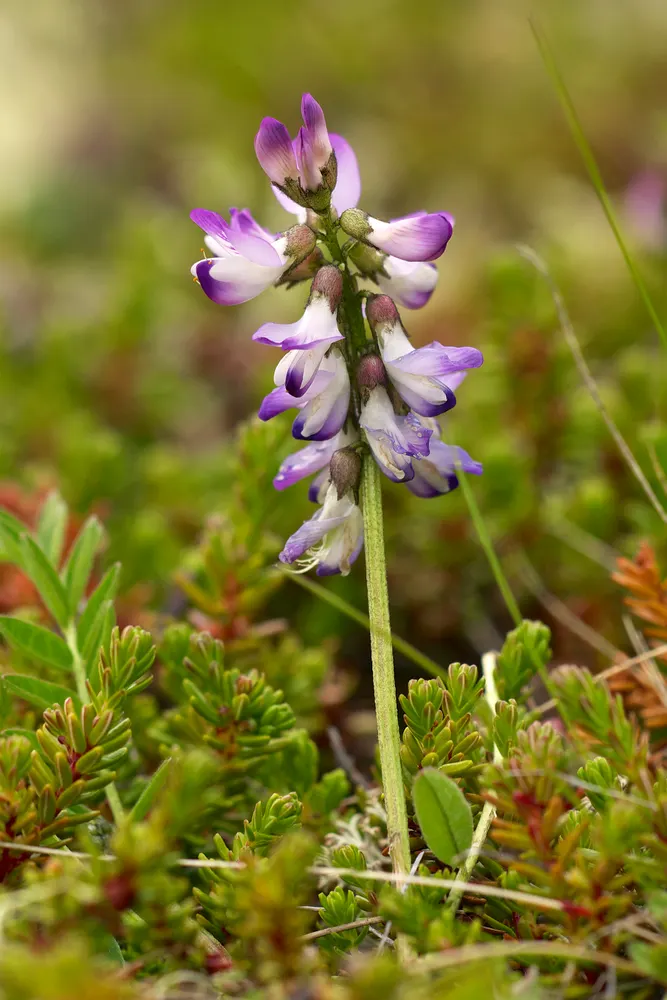
Photo: Jörg Hempel, CC BY-SA 3.0 de (via Wikimedia Commons)
Alpine Milk Vetch
Astragalus alpinus
Also known as Alpine Milkvetch
Key benefits
✦Traditional uses
✦Unlike its well-known cousin Astragalus membranaceus, the root long used in Chinese herbalism, Alpine Milk Vetch has never built up a solid, documented tradition as a food or medicine among the peoples who share its cold, wind-scoured range. Its real legacy is ecological rather than culinary: as a legume, it works quietly at the roots to fix nitrogen and enrich thin tundra and alpine soils, helping tougher, hungrier ground support more life. Caribou, ptarmigan, and other arctic wildlife have long grazed its foliage and pods, and botanists have prized it since Linnaeus first described the species in 1753 as one of the toughest, most far-flung legumes on earth. Today it earns its place mostly in rock gardens and native plantings, valued for its resilience and its cheerful purple spikes rather than for any cup, poultice, or plate.
How to grow & use it
✦The full apothecary for Alpine Milk Vetch
Traditional remedies and step-by-step preparations, a complete growing guide, and how to harvest, dry, and store it, all unlocked with HerbLens Unlimited.
- ✦Remedies & preparations
- ✦ Growing guide
- ✦Harvest & storage
From under $6 a month. Free plant identifications always included.
- ✦Moss campion
- ✦Mountain avens
- ✦Alpine saxifrage
- ✦Astragalus membranaceus (huang qi), for anyone seeking the traditionally used astragalus root
“For a corner of the garden that must survive where almost nothing else will, on windswept scree, gravel, and the thin, cold edges of the map.”
Alpine Milk Vetch is one of the most widely traveled legumes on the planet, growing wild in a continuous circle around the top of the world, from Alaska and the Canadian Arctic across Greenland and Scandinavia to the mountains of Siberia, wherever the ground thaws just long enough for a short, fierce summer of bloom.
Alpine milk vetch doesn't share the well-documented safety record of its relative Astragalus membranaceus (huang qi). Several wild vetches in this genus are toxic 'locoweeds' for grazing animals and have been fatally confused with poisonous lookalikes, so this one is best left for admiring, not foraging.