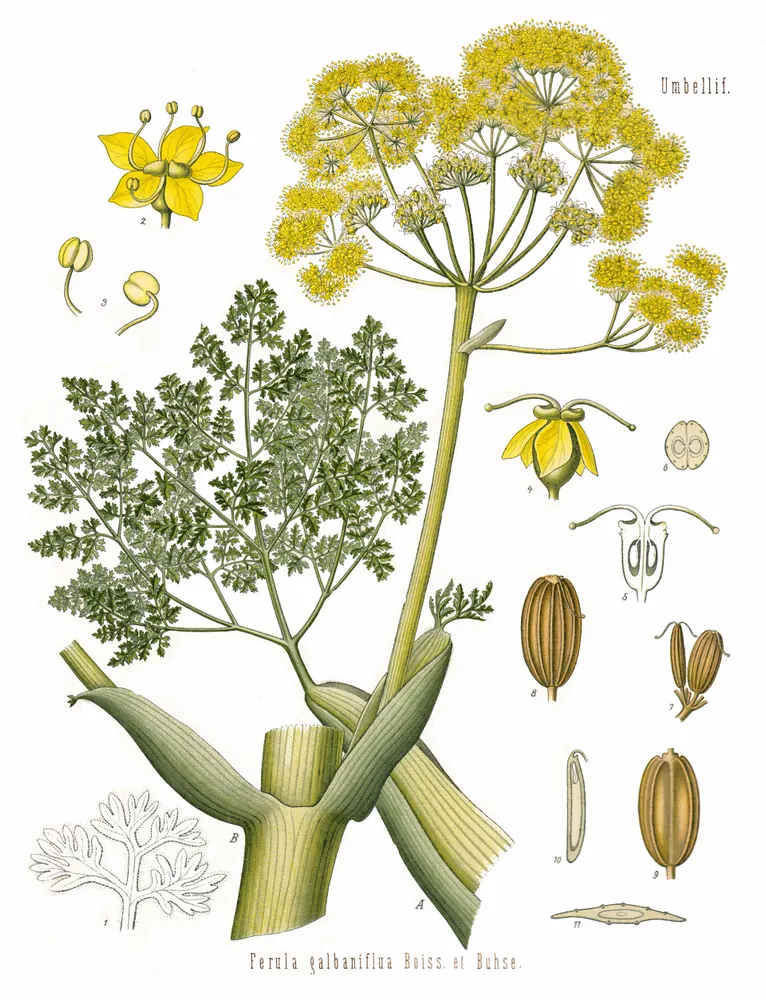
Photo: Unknown authorUnknown author, Public domain (via Wikimedia Commons)
Galbanum
Ferula gummosa
Also known as Galbanum Resin, Persian Galbanum, Gum Galbanum, Barijeh
Key benefits
✦Traditional uses
✦Long before it was a perfumer's secret, galbanum was temple medicine. Ancient Egyptian healers folded its resin into embalming compounds and wound plasters, and it appears by name in the book of Exodus as one of the four sacred ingredients burned as incense before the altar. Persian and Greek physicians, including Dioscorides, prized it as a warming remedy for coughs, chest congestion, and stubborn digestive troubles, often softening the raw resin over heat before applying it to the skin. That green, bitter, slightly bready scent that still defines galbanum today was, for thousands of years, the smell of being cared for.
How to grow & use it
✦The full apothecary for Galbanum
Traditional remedies and step-by-step preparations, a complete growing guide, and how to harvest, dry, and store it, all unlocked with HerbLens Unlimited.
- ✦Remedies & preparations
- ✦ Growing guide
- ✦Harvest & storage
From under $6 a month. Free plant identifications always included.
- ✦Frankincense
- ✦Myrrh
- ✦Juniper
- ✦Opoponax (sweet myrrh)
- ✦Frankincense resin
“For the green, resinous hush of an ancient sanctuary, bottled.”
Galbanum is named directly in the Old Testament as one of the four sacred spices commanded for the incense burned in the Tabernacle, making it one of the few herbs whose ceremonial use has been continuously recorded for over three thousand years.
Galbanum resin and oil are strong, so dilute in a carrier oil and patch test before topical use, since undiluted use can irritate skin. It's traditionally avoided in pregnancy as an emmenagogue, shouldn't be taken as a concentrated internal extract, and those allergic to Apiaceae plants (carrot, celery, fennel, dill) should watch for cross-reactions.