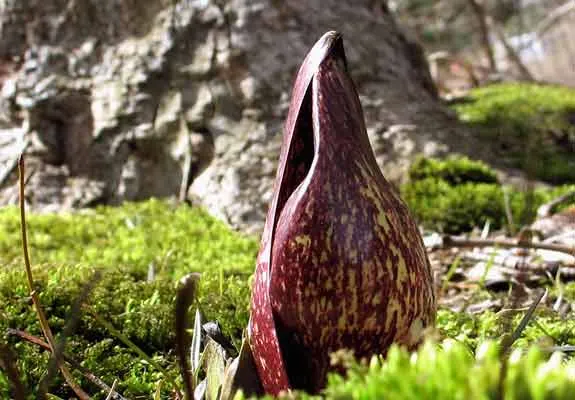
Photo: Sue Sweeney., CC BY-SA 3.0 (via Wikimedia Commons)
Skunk Cabbage
Symplocarpus foetidus
Also known as Eastern Skunk Cabbage, Swamp Cabbage, Meadow Cabbage, Polecat Weed
Key benefits
✦Traditional uses
✦Long before spring truly arrives, skunk cabbage is already at work, its hooded purple-brown spathes generating their own heat and melting a small clearing through the last of the winter snow. Several Native American nations, including the Menominee, Potawatomi, and Iroquois, dried and aged the root at length before using it in traditional preparations for coughs, asthma, and rheumatic complaints, and nineteenth-century Eclectic physicians later adopted it under the name Dracontium for similar respiratory complaints. That history matters, but it belongs to specialists who understood exactly how to process a genuinely difficult plant, not to home use. Today skunk cabbage is valued far more as a garden and woodland curiosity, one of the true harbingers that winter is losing its grip.
How to grow & use it
✦The full apothecary for Skunk Cabbage
Traditional remedies and step-by-step preparations, a complete growing guide, and how to harvest, dry, and store it, all unlocked with HerbLens Unlimited.
- ✦Remedies & preparations
- ✦ Growing guide
- ✦Harvest & storage
From under $6 a month. Free plant identifications always included.
- ✦Marsh marigold
- ✦Ostrich fern
- ✦Jack-in-the-pulpit
- ✦Marsh marigold (for early, moisture-loving garden color)
- ✦Bloodroot (for another native early spring woodland bloomer)
“For the gardener who wants to watch spring announce itself from the wet ground up, weeks before anything else dares to bloom.”
Skunk cabbage is one of the very few plants on earth capable of thermogenesis, meaning it can generate its own heat through rapid cellular respiration. Its spathe can run 20 to 35 degrees Fahrenheit warmer than the surrounding air, enough to melt a ring through snow and volatilize its skunky scent, which lures early carrion flies and beetles in to pollinate it while most other plants are still fast asleep for the winter.
Every part of skunk cabbage, leaf, root, and flower, is loaded with needle-shaped calcium oxalate crystals. Bite into it raw and those crystals lodge in the soft tissue of the mouth and throat, causing an intense burning sensation, swelling, and in some cases nausea or vomiting; the effect is the same mechanism that makes relatives like Jack-in-the-pulpit and dieffenbachia notorious as "mouth-burning" plants. The sap can also irritate bare skin on contact for sensitive individuals. Nineteenth-century root diggers and some Native healers reportedly rendered it usable only through long, careful drying and aging to break down the oxalates, a process that is not reliably reproducible or safe to attempt at home today, so this entry does not offer any preparation for internal use. It should be avoided entirely during pregnancy and breastfeeding, kept well away from children and pets who might be tempted by its bright hood-shaped flowers, and never gathered for eating. Treat this as a plant to observe and admire rather than to harvest for the kitchen or medicine cabinet, and speak with a qualified physician or clinical herbalist before considering any traditional plant remedy, especially one with a toxicity profile like this.