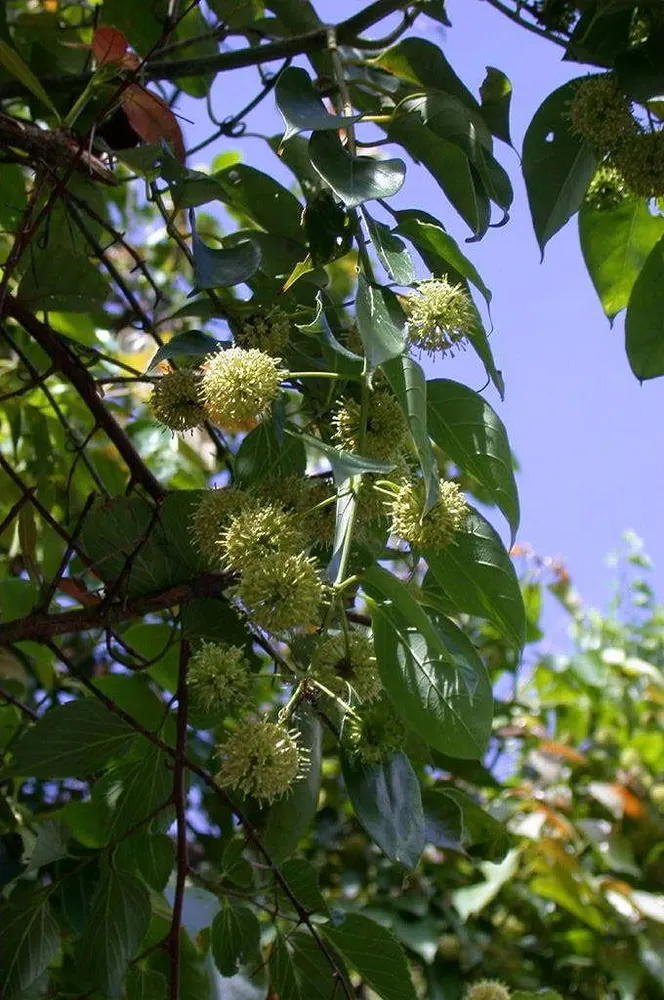
Photo: keisotyo, CC BY-SA 4.0 (via Wikimedia Commons)
Cat's Claw Vine
Uncaria rhynchophylla
Also known as Gou Teng, Hook Vine, Gambir Vine, Uncariae Ramulus Cum Uncis
Key benefits
✦Traditional uses
✦In Traditional Chinese Medicine, gou teng has been valued for centuries for calming what practitioners called internal wind, the trembling, dizziness, and headache thought to arise when the body's balance was disturbed. It found a place in classic formulas such as Tianma Gouteng Yin, prescribed for headache and vertigo, and it was often given to fretful, feverish children to help settle a racing, unsettled temperament. Herbalists were drawn to its curious hooked stems, small paired claws that let the vine grip and climb, and saw in that grasping shape a fitting symbol for an herb meant to steady and hold the body's wind in check. It was rarely used alone, more often simmered gently alongside companion herbs in a balanced formula.
Growing guide
✦Fresh to dried
✦Traditional preparations
✦Gou Teng Calming Decoction
A traditional short simmer used within TCM practice to help settle restlessness and an overactive mind, almost always as part of a larger herbal formula rather than alone.
How it's made. Traditionally, 3 to 6 grams of the dried hooked stems are added to a pot with other prescribed herbs and gently simmered for only 10 to 15 minutes, added near the end of cooking since practitioners have long held that prolonged boiling weakens its effect.
- ✦Chrysanthemum flower
- ✦Gastrodia (tian ma)
- ✦Cassia seed
- ✦Gastrodia elata
- ✦Uncaria tomentosa (a related but distinct species, used differently)
“For a mind that will not settle and a head that will not stop spinning.”
The genus name Uncaria comes from the Latin uncus, meaning hook, and Chinese herbalists gave the plant the same idea in its common name, gou teng, or hook vine, describing the small curved thorns it uses to climb that early practitioners thought resembled a cat's grasping claw.
Gou teng contains alkaloids that can lower blood pressure and heart rate, so don't combine it with blood pressure medication, sedatives, or heart medication without medical guidance. Safety in pregnancy and breastfeeding isn't established, and it's traditionally used briefly and as part of a formula rather than as an everyday tea.