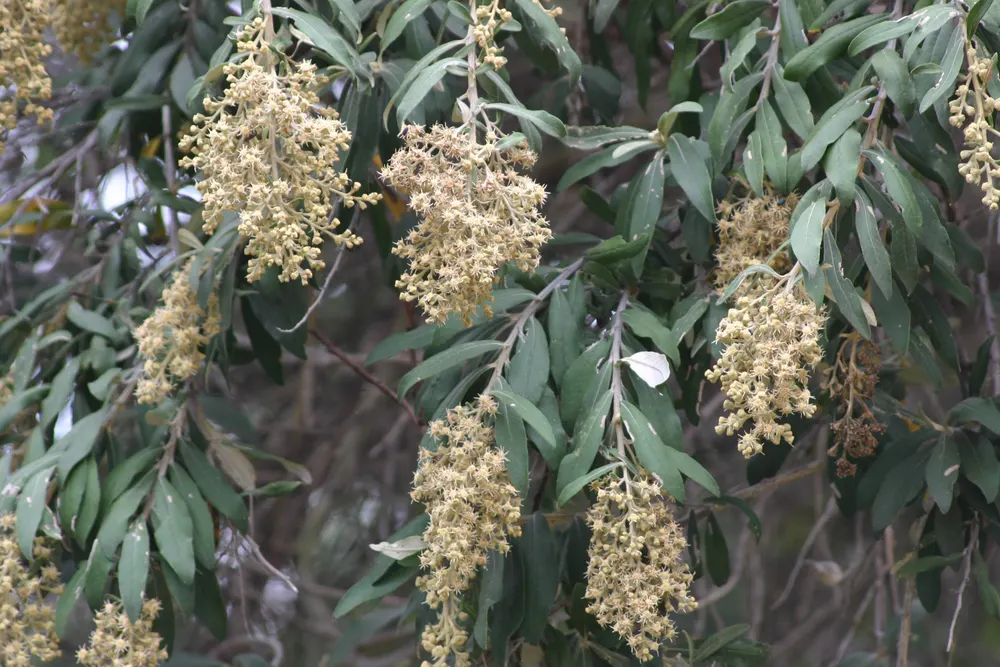
Photo: Paul venter, CC BY-SA 3.0 (via Wikimedia Commons)
Camphor Bush
Tarchonanthus camphoratus
Also known as Wild Camphor Bush, African Camphor Bush, Mfenyha, Umsuzwane, Muthee (Kikuyu)
Key benefits
✦Traditional uses
✦Long before it had a Latin name, camphor bush was already a fixture of the African bush pharmacy, its crushed leaves releasing a sharp, resinous scent that Maasai, Zulu, Xhosa, and Kikuyu communities came to rely on for chest colds, headaches, and stuffy noses. Leaves were burned as a fumigant, brewed into a mild infusion, or simply crumbled and inhaled, a quick remedy carried in a herder's pocket or hung inside a hut. The wood, dense and slow to rot, was carved into clubs and tool handles, while dried leaves tucked among stored grain or bedding were trusted to keep fleas and moths at bay. Even today it remains a familiar, everyday plant in the households and grazing lands where it grows wild.
How to grow & use it
✦The full apothecary for Camphor Bush
Traditional remedies and step-by-step preparations, a complete growing guide, and how to harvest, dry, and store it, all unlocked with HerbLens Unlimited.
- ✦Remedies & preparations
- ✦ Growing guide
- ✦Harvest & storage
From under $6 a month. Free plant identifications always included.
- ✦Eucalyptus
- ✦Wild mint
- ✦Rooibos
- ✦Eucalyptus leaf
- ✦Rosemary
“When a cold has settled into your chest and you want the kind of sharp, clean scent that seems to open a room.”
Camphor bush is dioecious, meaning male and female flowers grow on separate plants entirely. Only the females produce the plant's signature feature, soft silvery seed heads that blanket the branches like frost, which is why a whole hillside of camphor bush can look dramatically different from tree to tree depending on which sex took root.
Camphor bush's aromatic oils are meant to be used lightly in dilute traditional preparations, never as a concentrated extract or essential oil taken by mouth, which can be toxic even in small doses. It should be avoided by infants, young children, anyone with a seizure disorder, and during pregnancy or breastfeeding, and used with caution alongside sedative or respiratory medications.