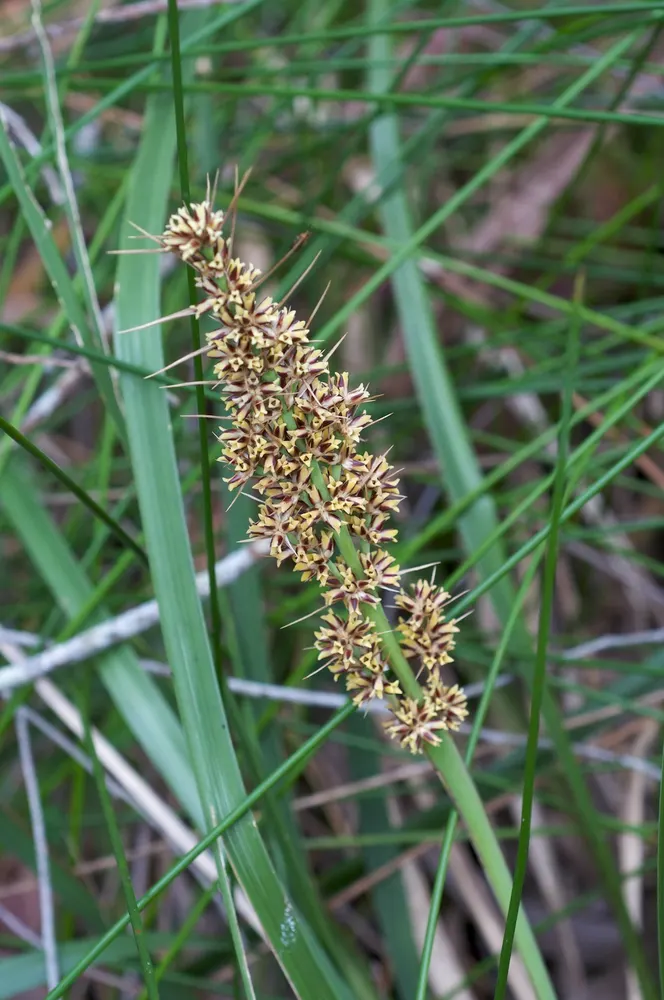
Photo: Eric in SF, CC BY-SA 3.0 (via Wikimedia Commons)
Spiny-headed Mat Rush
Lomandra longifolia
Also known as Mat Rush, Basket Grass, Spiny Mat-rush, Spiny-head Mat-rush
Key benefits
✦Traditional uses
✦Long before it was a landscaper's favorite, Lomandra longifolia was a working plant in the hands of Aboriginal Australians, whose communities have used its long, fibrous leaves for countless generations to weave dilly bags, mats, baskets, fishing nets, and eel traps. The leaves were split, softened, and sometimes dyed to make the fiber pliable enough for intricate coiled and twined work, a craft still practiced and taught today. The tender white base of the leaf was chewed for its faint sweetness, almost like a wild celery, and the nectar-rich flowers were sometimes sucked straight from the spike for a small burst of sweetness in the bush. It has always been valued more as a plant of practical survival and craft than as a medicine.
How to grow & use it
✦The full apothecary for Spiny-headed Mat Rush
Traditional remedies and step-by-step preparations, a complete growing guide, and how to harvest, dry, and store it, all unlocked with HerbLens Unlimited.
- ✦Remedies & preparations
- ✦ Growing guide
- ✦Harvest & storage
From under $6 a month. Free plant identifications always included.
- ✦Dianella (flax lily)
- ✦Kangaroo paw
- ✦Native grevillea
- ✦Dianella species (flax lily)
- ✦Carex species (native sedge)
“For the sunbaked slope where nothing else will hold, and the basket that needs to keep its shape for a hundred years.”
The genus name Lomandra comes from the Greek loma, meaning fringe, and andros, meaning male, a nod to the small fringed appendages on the male flowers. In the garden, this humble tussock does quiet ecological work too, since its leaves are the sole food source for the caterpillars of several native Australian skipper butterflies, which lay their eggs nowhere else.
Lomandra isn't toxic, but its stiff, sharp leaf tips can cause cuts, so gloves are sensible when harvesting. Only eat the tender leaf base or flowers after certain identification, since look-alike grasses and rushes exist.