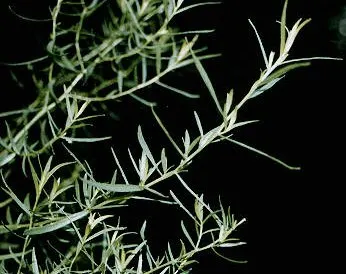
Photo: No machine-readable author provided. Ies assumed (based on copyright claims)., Public domain (via Wikimedia Commons)
Tarragon (French Tarragon)
Artemisia dracunculus
Also known as French Tarragon, Estragon, Dragon's Wort
Key benefits
✦Traditional uses
✦French tarragon has long held court in French kitchens as l'herbe au dragon, the anise-sweet backbone of béarnaise sauce, fines herbes, and roasted poultry. Long before it was prized purely for flavor, cooks and healers used it after rich meals, steeped into a simple tea to ease digestion and coax back a flagging appetite. Country folk once chewed the fresh leaves to numb an aching tooth, a practice tied to the same aromatic compounds that give tarragon its distinctive bite. Its old species name, dracunculus, or little dragon, is thought to nod either to its coiling, serpentine roots or to a folk belief that the plant could draw out the venom of snakebites and stings.
How to grow & use it
✦The full apothecary for Tarragon (French Tarragon)
Traditional remedies and step-by-step preparations, a complete growing guide, and how to harvest, dry, and store it, all unlocked with HerbLens Unlimited.
- ✦Remedies & preparations
- ✦ Growing guide
- ✦Harvest & storage
From under $6 a month. Free plant identifications always included.
- ✦Chervil
- ✦Parsley
- ✦Chives
- ✦Anise hyssop
- ✦Fennel fronds
“When a dish calls for something delicate, anise-sweet, and unmistakably French.”
French tarragon almost never flowers or sets viable seed, so every plant in cultivation is grown from a cutting or root division of an older plant, an unbroken chain of clones stretching back centuries, unlike its coarser, seed-grown cousin Russian tarragon.
Tarragon is safe in the amounts used for cooking. It contains estragole, so concentrated tinctures or essential oil aren't advised, and its mild traditional blood-thinning effect means caution if you're on anticoagulant medication or pregnant.