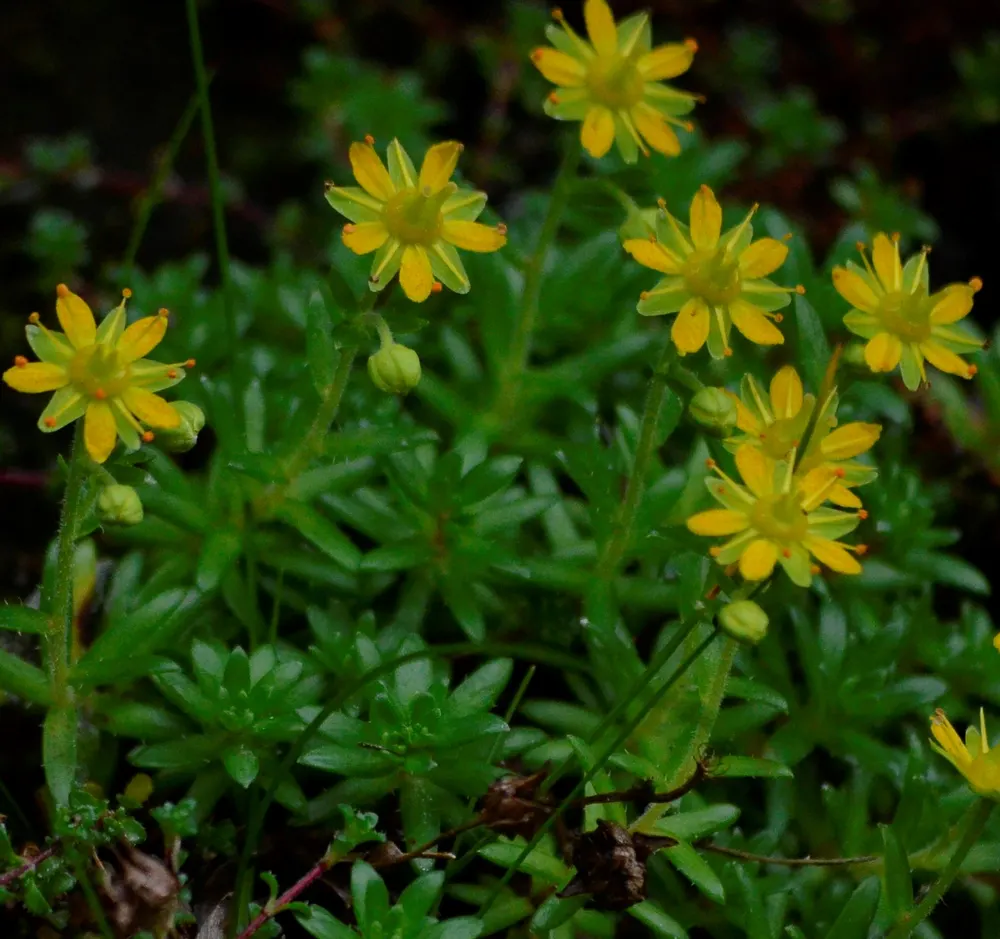
Photo: Iangpark, CC BY-SA 4.0 (via Wikimedia Commons)
Yellow Mountain Saxifrage
Saxifraga aizoides
Also known as Yellow Mountain Saxifrage, Yellow Saxifrage
Key benefits
✦Traditional uses
✦Yellow Mountain Saxifrage is not a famous medicine chest herb, but it has quietly earned its keep among mountain walkers and rock gardeners for centuries. Its whole family carries an old story in its name: saxifrage comes from the Latin for rock breaker, because early herbalists watched these little plants root themselves into solid stone and, following the doctrine of signatures, decided a plant that could split rock might help the body pass its own stones. That belief attached most strongly to a cousin species used in European folk medicine, while Yellow Mountain Saxifrage itself was valued more simply, as one of the first cheerful blooms after snowmelt and as a sharp, refreshing nibble for foragers crossing wet alpine ground. In cottage and rock gardens it has long been prized for carpeting damp stone where nothing tidier will grow.
How to grow & use it
✦The full apothecary for Yellow Mountain Saxifrage
Traditional remedies and step-by-step preparations, a complete growing guide, and how to harvest, dry, and store it, all unlocked with HerbLens Unlimited.
- ✦Remedies & preparations
- ✦ Growing guide
- ✦Harvest & storage
From under $6 a month. Free plant identifications always included.
- ✦Wood sorrel
- ✦Garden sorrel
- ✦Chickweed
- ✦Wood sorrel
- ✦Garden sorrel
“For the first gold stars of thaw, scattered across a wet mountain ledge.”
The genus name Saxifraga literally means stone breaker, from the Latin saxum for rock and frangere to break, a nod to how these tenacious little plants wedge their roots into cracks in solid stone and, over years, help split it apart.
No significant toxicity is known, and foragers have eaten small amounts of the fresh, tangy leaves. Positive identification matters, since safe and unsafe alpine look-alikes can grow side by side.