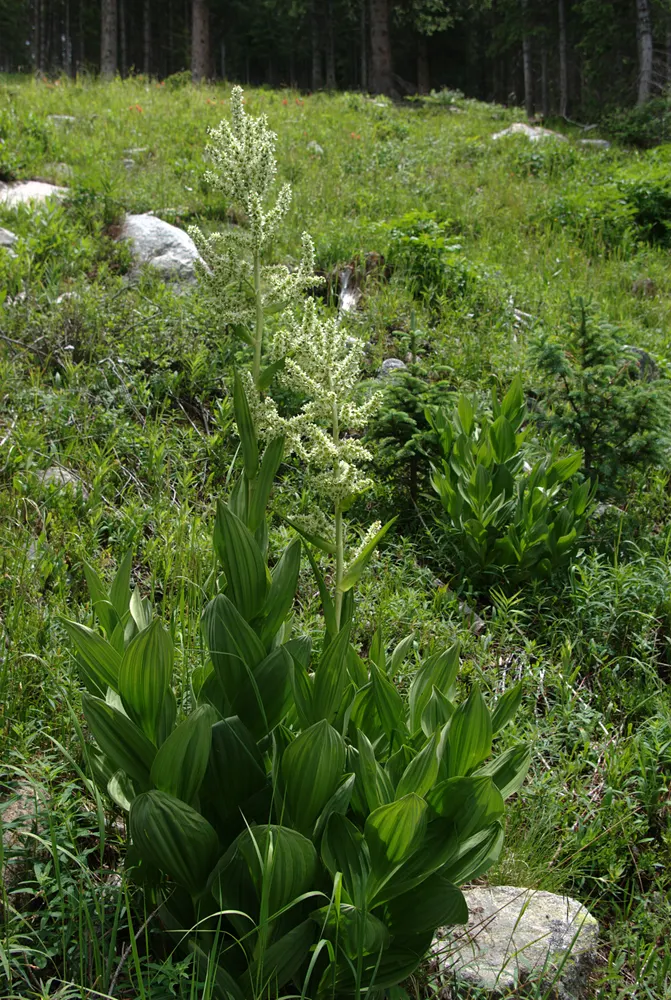
Photo: JerryFriedman, CC BY-SA 3.0 (via Wikimedia Commons)
California Corn Lily
Veratrum californicum
Also known as California False Hellebore, Corn Lily, Skunk Cabbage (regional), Western False Hellebore
Traditional uses
✦California corn lily has a long history in western North America, but almost entirely as a plant to know and avoid rather than one to use. Some Indigenous groups in the West prepared the root with great caution and specialized knowledge for very limited external and ceremonial purposes, but this was never a casual kitchen or home remedy plant. Ranchers came to know it grimly through livestock losses, and it was this plant, growing thick in Idaho sheep pastures, that led scientists in the 1950s and 60s to discover cyclopamine, the toxic alkaloid responsible for devastating birth defects in lambs born to ewes that grazed it during pregnancy. That discovery later became an important tool in cancer and developmental biology research, a strange twist in which one of the West's most dangerous wildflowers helped illuminate how healthy embryos are built.
How to grow & use it
✦The full apothecary for California Corn Lily
Traditional remedies and step-by-step preparations, a complete growing guide, and how to harvest, dry, and store it, all unlocked with HerbLens Unlimited.
- ✦Remedies & preparations
- ✦ Growing guide
- ✦Harvest & storage
From under $6 a month. Free plant identifications always included.
“A tall green sentinel of the high meadow, best known from a respectful distance.”
The compound cyclopamine, isolated from this plant after it caused sheep in Idaho to be born with a single central eye, is now used in cancer laboratories worldwide to study and block the same embryonic signaling pathway that goes awry in certain tumors.
Veratrum californicum is highly toxic and should never be ingested, foraged for food or medicine, or handled carelessly. Every part of the plant contains steroidal alkaloids, including cyclopamine and jervine, that are severely poisonous to humans and animals, causing nausea, vomiting, dangerously low blood pressure, irregular heartbeat, and in serious cases death. It is also a potent teratogen, meaning exposure during pregnancy can cause severe birth defects, and it is famous among ranchers for causing cyclopia and other malformations in the offspring of livestock that graze it. Young corn lily shoots are sometimes mistaken for edible plants like wild onion or false hellebore's more benign lookalikes, so foragers should learn to identify it with certainty and avoid it entirely. This plant has no place in home teas, tinctures, or remedies. If you suspect exposure or poisoning, contact poison control or a medical professional immediately, and always consult a qualified healthcare provider before using any wild plant.