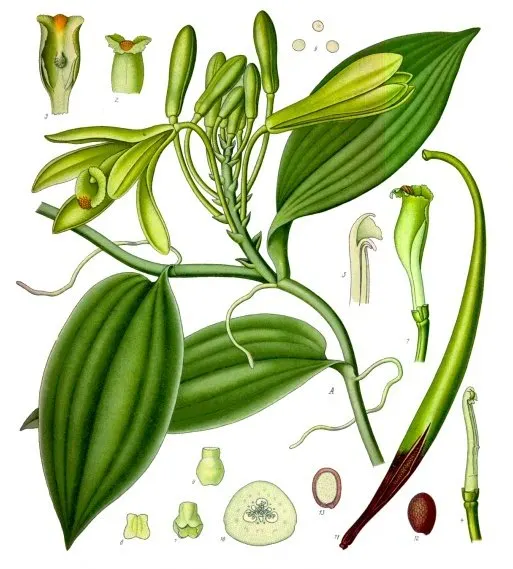
Photo: Franz Eugen Köhler, Köhler's Medizinal-Pflanzen, Public domain (via Wikimedia Commons)
Vanilla
Vanilla planifolia
Also known as Vanilla Orchid, Flat-leaved Vanilla, Bourbon Vanilla, Xanat (Totonac)
Key benefits
✦Traditional uses
✦Vanilla was first cultivated by the Totonac people of Veracruz, Mexico, who called it xanat and wove it into ceremony, perfume, and medicine long before the Aztecs conquered their lands and carried the pods home to flavor royal cacao drinks. Totonac healers traditionally used vanilla as a tonic for the stomach and nerves, and Aztec physicians valued it as a stimulant and comforting agent when blended with chocolate. When Spanish colonizers brought vanilla to Europe in the sixteenth century, it became prized both as a flavoring and as a gentle remedy believed to ease digestion and lift low spirits. To this day, in the region around Papantla, Mexico, vanilla is still grown and cured using methods passed down through generations of Totonac farmers.
How to grow & use it
✦The full apothecary for Vanilla
Traditional remedies and step-by-step preparations, a complete growing guide, and how to harvest, dry, and store it, all unlocked with HerbLens Unlimited.
- ✦Remedies & preparations
- ✦ Growing guide
- ✦Harvest & storage
From under $6 a month. Free plant identifications always included.
- ✦Cacao
- ✦Mexican cinnamon (canela)
- ✦Chamomile
- ✦Cardamom
- ✦Almond extract
“When you want warmth and comfort in a bottle, something to settle the stomach and soften the edges of the day.”
Vanilla is the second most expensive spice in the world after saffron, largely because outside Mexico it has no natural pollinator. Every flower on every commercial vine elsewhere must be pollinated by hand, one blossom at a time, within the single morning it is open.
True vanilla is a safe, common flavoring in ordinary culinary amounts. Extract is steeped in alcohol so it is meant for cooking rather than drinking straight, and handling raw, uncured pods can irritate skin.