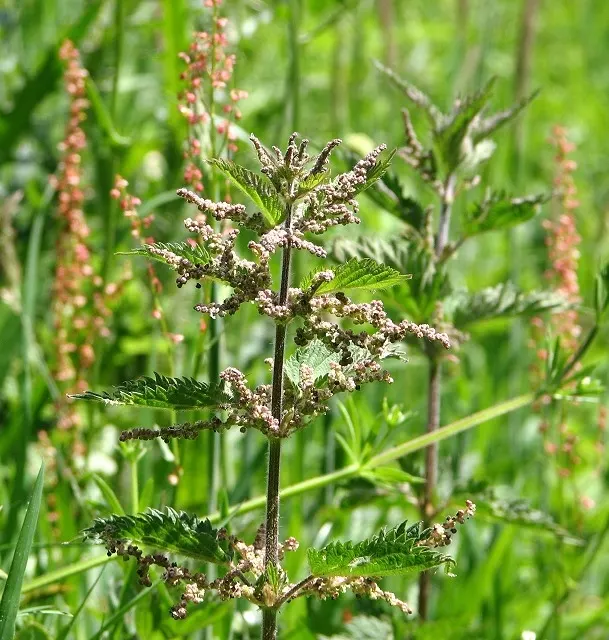
Photo: Evelyn Simak, CC BY-SA 2.0 (via Wikimedia Commons)
Nettle
Urtica dioica
Also known as Stinging Nettle, Common Nettle, Burn Nettle, Common Nettle Leaf
Key benefits
✦Traditional uses
✦Nettle has been gathered as both food and medicine for thousands of years, long before it earned its prickly reputation as a garden nuisance. Old European herbalists prized it as a spring tonic, a way to shake off winter's sluggishness with a plant bursting with minerals right when fresh greens were scarce. Farmers and healers also practiced urtication, deliberately brushing the fresh, stinging leaves over sore joints in the traditional belief that the brief sting eased the deeper ache of rheumatism afterward. Beyond the home apothecary, nettle's tough fibers were spun into cloth and cordage for centuries, making it one of the most quietly useful plants a household could have growing at the edge of the yard.
How to grow & use it
✦The full apothecary for Nettle
Traditional remedies and step-by-step preparations, a complete growing guide, and how to harvest, dry, and store it, all unlocked with HerbLens Unlimited.
- ✦Remedies & preparations
- ✦ Growing guide
- ✦Harvest & storage
From under $6 a month. Free plant identifications always included.
- ✦Peppermint
- ✦Oat straw
- ✦Red raspberry leaf
- ✦Alfalfa leaf
- ✦Red clover
“When you want the deep green, mineral-rich lift of the first honest greens of spring.”
Nettle's fibers are strong enough to spin into thread, and during World War I, when cotton grew scarce, the German army reportedly turned to nettle cloth for uniforms.
Fresh nettle leaves sting on contact, but cooking or drying neutralizes this and makes the plant safe to eat. Its mild diuretic effect calls for caution alongside diuretics, lithium, or blood pressure medication, and its effect on clotting calls for caution with blood thinners. Concentrated root preparations are best avoided in pregnancy.